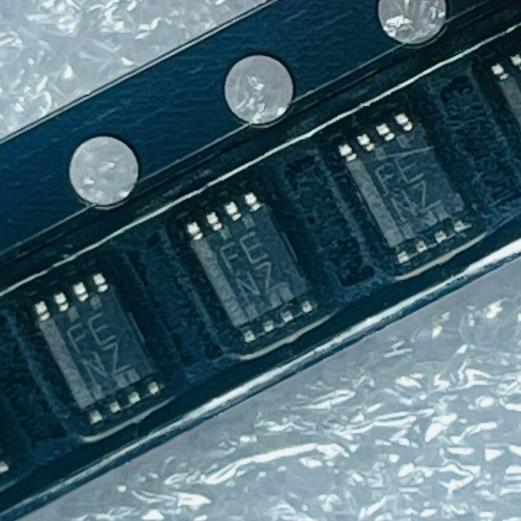
The TXS0102DCUR is a 2-bit bidirectional voltage-level translator from Texas Instruments designed for mixed-voltage systems where I²C, UART, GPIO, or other digital signals must cross between different voltage domains. It requires no direction-control signal — each channel automatically senses and translates in both directions, simplifying board design.
The A port operates from 1.65 V to 3.6 V (tracking VCCA), and the B port operates from 2.3 V to 5.5 V (tracking VCCB), with the constraint VCCA ≤ VCCB. This covers all common logic voltage combinations: 1.8 V-to-3.3 V, 1.8 V-to-5 V, 3.3 V-to-5 V, and 2.5 V-to-3.3 V.
The TXS architecture uses passive pass-transistor switches with edge-rate accelerators. For open-drain buses (I²C, SMBus), the pass-FET provides a low-impedance path and the one-shot accelerator briefly turns on a strong pull-up to speed rising edges, achieving up to 2 Mbps. For push-pull signals (UART, SPI, GPIO), the accelerator provides fast edges up to 24 Mbps.
The VCC isolation feature ensures that if either VCCA or VCCB is at GND, both ports enter a high-impedance state, preventing back-feeding. The Ioff circuitry supports partial-power-down mode, allowing one side to be powered down while the other remains active without leakage. No power-supply sequencing is required — either rail can ramp first.
ESD protection is asymmetric: the A port provides 2.5-kV HBM, while the B port (facing the higher-voltage, often external-facing side) provides 8-kV HBM. The OE pin, when pulled low, places all I/Os in high-impedance state with reduced quiescent current. The VSSOP-8 (DCU) package occupies only 4.6 mm² of board area, making it ideal for space-constrained portable designs.





 English
  简体中文
简体中文  Español
  العربية