The MMBT2907ALT1G from onsemi is a -60V PNP silicon bipolar junction transistor (BJT) designed for general-purpose linear and switching applications in a surface-mount SOT-23 package. It is the SMD equivalent of the industry-standard 2N2907A PNP transistor, one of the most widely used small-signal PNP transistors since the 1960s. The MMBT version brings the same trusted electrical characteristics to modern surface-mount designs.
The 2N2907/2N2222 complementary pair (PNP/NPN respectively) is arguably the most classic transistor complementary pair in electronics. The MMBT2907A and MMBT2222A maintain this complementary relationship in the SOT-23 surface-mount package, enabling push-pull amplifier stages, H-bridge motor drivers, and other complementary circuit topologies in compact SMD designs.
The device is AEC-Q101 qualified, meaning it has passed the rigorous reliability testing required for automotive electronics applications, including temperature cycling, high-temperature operating life (HTOL), humidity bias, and electrostatic discharge (ESD) testing. This qualification makes the MMBT2907ALT1G suitable for under-hood automotive applications and any environment demanding high reliability.
The PNP polarity means that conventional current flows from emitter to collector when the transistor is conducting. In a typical low-side PNP switch configuration, the emitter is connected to the positive supply, the load is between the collector and ground, and the base is pulled low (below the emitter voltage by approximately 0.7V) to turn on the transistor. This is the mirror image of the more common NPN low-side switch, where the emitter is at ground and the base is driven high.
The hFE (DC current gain) ranges from 100 to 300 at IC=-10mA, VCE=-10V, providing substantial gain for small-signal applications. At higher currents (IC=-500mA), the minimum hFE drops to 50, which still provides useful gain for medium-power switching. The gain variation with current and temperature must be considered in circuit design; worst-case design should use the minimum hFE at the maximum operating current and temperature.
The transition frequency (fT) of 200MHz indicates the frequency at which the common-emitter current gain drops to unity (0dB). In practice, the useful bandwidth for amplifier applications is fT / hFE, which for hFE=100 gives approximately 2MHz. This is adequate for audio and many general-purpose applications but insufficient for RF applications above a few MHz.
The SOT-23 package is the most widely used surface-mount transistor package, with a footprint of only 2.9 x 1.3 mm. The power dissipation is limited to 350mW when mounted on a standard FR-4 PCB with recommended pad layout, due to the small thermal mass and limited heat spreading area. For higher power applications, the through-hole 2N2907A in a TO-18 or TO-92 package provides better thermal performance.
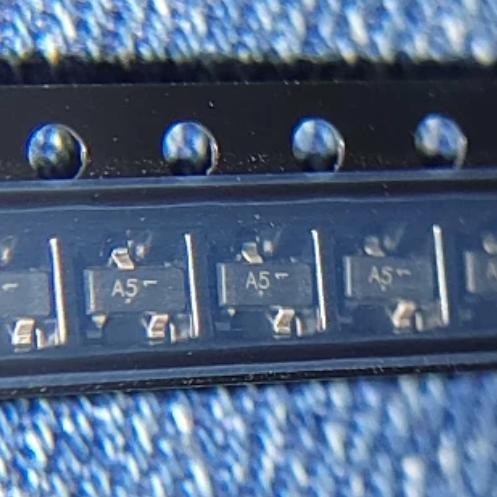
The marking code for the MMBT2907A is ‘2B’, which must be distinguished from other SOT-23 devices with similar markings. The L suffix in MMBT2907ALT1G indicates AEC-Q101 qualification, and the T1G suffix indicates tape-and-reel packaging with Pb-free termination finish.





 English
  简体中文
简体中文  Español
  العربية