首页 > 集成电路 IC > LM1117S-3.3

LM1117S-3.3


3.3V 固定 LDO,1A 输出,1.2V 压降,5mA Iq,PSRR 75dB,SOT-223,-40~125C,需要 10uF Cout

100000

有效库存
转到查询

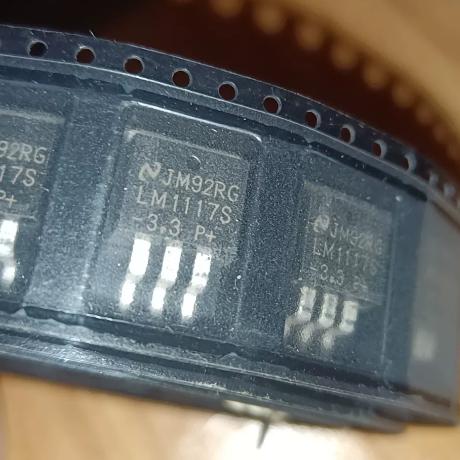
Image for reference only

制造商零件:

LM1117S-3.3

包装:

SOT-223-3(6.5 x 3.5 毫米,2.54 毫米间距)

品牌:
您可能感兴趣的其他建议.
说明

The LM1117S-3.3 is a fixed 3.3 V low-dropout (LDO) linear voltage regulator in a SOT-223-3 surface-mount package, capable of delivering up to 1 A output current. Key specifications: fixed output voltage 3.3 V (plus or minus 1 percent accuracy); maximum input voltage 15-20 V; dropout voltage 1.2 V typical at 1 A output current (1.1 V at 800 mA); line regulation 0.1 percent max; load regulation 0.2 percent max; quiescent current 5 mA typical; output noise 100 uV; PSRR 75 dB at 120 Hz; internal current limiting and thermal shutdown protection; requires minimum 10 uF output capacitor for stability (tantalum or aluminum electrolytic recommended); operating junction temperature -40 to +125 degrees C; thermal resistance junction-to-ambient 130-137 degrees C/W (SOT-223). The S suffix denotes SOT-223 package; the -3.3 suffix denotes fixed 3.3 V output. Widely second-sourced by multiple manufacturers including HTC Korea TAEJIN Tech, TI, ON Semiconductor, Diodes Inc, and others. RoHS compliant. Active product status.

The LM1117S-3.3 is one of the most widely used low-dropout (LDO) voltage regulators in the electronics industry, providing a fixed 3.3 V output at up to 1 A from a higher input voltage. It is the de facto standard 3.3 V regulator for embedded systems, IoT devices, Arduino shields, and virtually any circuit that needs a 3.3 V rail from a 5 V or higher supply.

The LM1117 family was originally introduced by National Semiconductor (now part of TI) as an improved replacement for the older LM317 adjustable regulator in fixed-voltage applications. The key improvement is the lower dropout voltage: 1.2 V typical at 1 A for the LM1117 versus 2-3 V for the LM317. This means the LM1117S-3.3 can regulate 3.3 V from an input as low as 4.5 V, while the LM317 would need at least 5.3 V.

The LM1117S-3.3 is a commodity part, widely second-sourced by dozens of manufacturers. The most common sources include HTC Korea TAEJIN Technology, Texas Instruments (TLV1117), ON Semiconductor (NCP1117), Diodes Incorporated (AZ1117), Advanced Monolithic Systems (AMS1117), and many others. While the basic specifications are similar across manufacturers, the exact dropout voltage, output accuracy, and stability requirements can vary slightly. Always consult the specific manufacturer’s datasheet.

The 3.3 V output voltage is by far the most popular variant, driven by the ubiquitous use of 3.3 V logic in modern digital ICs, microcontrollers, and wireless modules. The LM1117 family also offers fixed output voltages of 1.2 V, 1.5 V, 1.8 V, 2.5 V, and 5.0 V, plus an adjustable version (LM1117S-ADJ) that uses an external resistor divider to set any output voltage from 1.25 V to 13.8 V.

The SOT-223-3 package is the most common package for the LM1117. It is a surface-mount package with three pins (GND/ADJ, VOUT, VIN) plus a large tab that is electrically connected to pin 2 (VOUT) and serves as a heat sink. The tab must be soldered to a copper pad on the PCB for proper heat dissipation. The thermal resistance from junction to ambient is approximately 130 degrees C/W with minimal PCB copper, but can be reduced to 50-80 degrees C/W with a large copper area under the tab.

The LM1117 requires an output capacitor of at least 10 uF for stability. Unlike newer LDO regulators that are stable with ceramic capacitors, the LM1117 was designed for tantalum or aluminum electrolytic capacitors with higher ESR. Using low-ESR ceramic capacitors can cause instability (oscillation) unless a series resistor is added to simulate the ESR. Many modern designs use a 10 uF tantalum or a 22 uF ceramic with a 1 Ohm series resistor.

At $0.09 per unit in volume, the LM1117S-3.3 is one of the most cost-effective ways to generate a 3.3 V rail. However, designers should be aware of its limitations: relatively high quiescent current (5 mA), high dropout voltage (1.2 V), and limited PSRR (75 dB). For battery-powered or noise-sensitive applications, newer LDO regulators such as the TLV1117LV33, AP2112, or RT9013 offer lower Iq, lower dropout, and better noise performance at a slightly higher cost.

The LM1117S-3.3 operates as a series-pass linear voltage regulator using a PNP pass transistor to achieve low dropout voltage.

Series-Pass Topology: The LM1117 uses a PNP transistor as the series-pass element between the input (VIN) and output (VOUT). Unlike NPN-based regulators (like the LM317) where the base drive must be higher than the output voltage (requiring VCC headroom), the PNP transistor is driven from the output side, so the minimum input-output differential is determined only by the transistor’s VCE(sat) voltage, which is approximately 1.2 V at 1 A. This is the fundamental reason the LM1117 can regulate with less dropout than NPN-based regulators.

Voltage Reference and Error Amplifier: An internal bandgap voltage reference generates a stable reference voltage. For the fixed 3.3 V version, an internal resistor divider scales the output voltage down to the reference voltage level. The error amplifier compares the divided output voltage with the reference voltage and drives the base of the PNP pass transistor to maintain the output at 3.3 V. Any change in output voltage (due to load current, input voltage, or temperature) is corrected by the feedback loop adjusting the pass transistor drive.

Feedback Loop Stability: The LM1117 is a feedback control system that requires a minimum output capacitance (10 uF) for stability. The output capacitor creates a dominant pole in the feedback loop’s frequency response. Without sufficient capacitance (or with a capacitor that has too low ESR), the loop can oscillate. The LM1117 was designed when tantalum capacitors (with ESR of 0.5-5 Ohms) were standard, so it relies on a certain amount of ESR for phase margin. When using modern low-ESR ceramic capacitors, a small series resistance (0.5-2 Ohms) must be added to ensure stability.

Current Limiting: The LM1117 includes an internal current-limiting circuit that protects the pass transistor from damage due to output short circuits. When the output current exceeds approximately 1.2-1.6 A (depending on manufacturer), the current limiter reduces the pass transistor drive, preventing further current increase. The current limit is temperature-dependent and increases at lower temperatures.

Thermal Shutdown: A thermal shutdown circuit monitors the junction temperature. When the junction temperature exceeds approximately 150-165 degrees C (depending on manufacturer), the thermal shutdown circuit turns off the pass transistor, reducing the output current to near zero. This prevents damage from excessive power dissipation (e.g., output short circuit with high input voltage). The thermal shutdown has approximately 10-20 degrees C of hysteresis to prevent oscillation near the threshold. When the junction temperature drops below the threshold, the regulator resumes normal operation.

Dropout Voltage: The dropout voltage is the minimum input-output voltage differential required for regulation. For the LM1117S-3.3, the dropout voltage is 1.2 V typical at 1 A. At lower output currents, the dropout voltage decreases: approximately 1.1 V at 800 mA, 0.9 V at 500 mA, and 0.3 V at 100 mA. This is because the PNP transistor VCE(sat) decreases with decreasing collector current. The minimum input voltage for a 3.3 V output is therefore 3.3 + 1.2 = 4.5 V at full load.

Quiescent Current: The ground pin current (quiescent current) is approximately 5 mA typical and varies with load current. At light loads, the Iq is primarily the bias current for the internal reference and error amplifier. At full load, additional current flows through the base drive of the PNP pass transistor, increasing the total Iq to approximately 10-15 mA. This Iq is significantly higher than modern low-Iq LDOs (which can be under 1 uA at light load), making the LM1117 less suitable for battery-powered always-on applications.

针脚 名称 类型 说明
1 GND/ADJ 地面 Ground connection for fixed-voltage version (LM1117S-3.3); connect to PCB ground plane; for the adjustable version (LM1117S-ADJ), this pin is the adjust (ADJ) feedback input connected to an external resistor divider; for the 3.3 V fixed version, this pin must be connected to ground for proper regulation; the tab on the SOT-223 package is connected to pin 2 (VOUT), not to ground
2 VOUT 输出 Regulated 3.3 V output; capable of sourcing up to 1 A continuous current; requires a minimum 10 uF output capacitor for stability (tantalum or aluminum electrolytic recommended; if using ceramic, add 0.5-2 Ohm series resistance for ESR); connect the large SOT-223 tab to this pin on the PCB for heat dissipation; output voltage accuracy is typically plus or minus 1 percent over line, load, and temperature
3 VIN 输入 Unregulated input voltage; 4.5 V minimum (for 3.3 V output at 1 A) to 15-20 V maximum; bypass with 10 uF tantalum or ceramic capacitor to GND if the input source is more than a few inches away; the input capacitor helps prevent oscillation and improves transient response; input current equals output current plus quiescent current (approximately 5-15 mA)
选项卡 VOUT 热能 The metal tab on the back of the SOT-223 package is electrically connected to pin 2 (VOUT); solder the tab to a copper pad on the PCB for thermal management; the copper pad area determines the effective thermal resistance; a 1 square inch copper pad reduces theta-JA from 130 degrees C/W to approximately 80 degrees C/W; for maximum power dissipation, use a thermal via array under the pad
应用 说明
3.3V MCU Power Supply Convert 5 V to 3.3 V for STM32, ESP8266, ESP32, NRF24L01, and other 3.3 V microcontrollers and wireless modules; 1 A output sufficient for MCU plus peripherals; 1.2 V dropout allows operation from 5 V with 0.5 V margin; low cost ($0.09 at 1K) makes it ideal for cost-sensitive designs; SOT-223 package saves board space
Arduino 3.3V Shield Provide 3.3 V rail on Arduino shields and expansion boards; the LM1117S-3.3 is the most commonly used regulator on Arduino-compatible boards; converts the Arduino 5 V supply to 3.3 V for 3.3 V sensors, displays, and radio modules; easy hand-soldering in SOT-223 package
SMPS Post-Regulator Filter and regulate the output of a switching power supply; the LM1117 provides a clean 3.3 V rail with 75 dB PSRR at 120 Hz, reducing switching ripple and noise; place close to the load for best transient response; 10 uF tantalum output capacitor provides both stability and additional filtering
Battery-Powered Device Regulate Li-ion battery (3.7-4.2 V) to 3.3 V; at full battery voltage (4.2 V), the dropout is only 0.9 V, well within spec; as the battery discharges to 3.6 V, the dropout decreases to 0.3 V, still within regulation; however, when battery drops below 4.5 V under load, the regulator may drop out; consider lower-dropout alternatives for full battery utilization
IoT Sensor Node Power 3.3 V sensors (temperature, humidity, pressure, gas) from a 5 V bus; 1 A capacity handles multiple sensors and wireless transmitter; thermal shutdown protects against fault conditions; low component count (just the regulator and two capacitors) simplifies BOM and PCB layout
模型 制造商 兼容性 主要区别
AMS1117-3.3 AMS/Advanced Monolithic Pin-Compatible Equivalent Same 3.3 V LDO in SOT-223; pin-compatible; similar specifications (1 A, 1.1 V dropout); extremely popular in Chinese-manufactured boards; often interchangeable with LM1117S-3.3; verify dropout and stability requirements from specific manufacturer datasheet
TLV1117LV33DCYR TI Pin-Compatible, Lower Iq Modern TI version of LM1117 in SOT-223; lower quiescent current (500 uA vs 5 mA); lower dropout (1.06 V at 800 mA); stable with ceramic capacitors; pin-compatible; recommended as direct replacement for new designs needing lower power consumption
NCP1117ST33T3G ON Semiconductor Pin-Compatible Equivalent 3.3 V LDO in SOT-223; pin-compatible; very similar specifications; 1 A output; 1.3 V dropout; ON Semi version of the LM1117; widely available; stable with tantalum or ceramic with ESR
AP2112K-3.3 二极管公司 Smaller Package, Lower Iq 3.3 V LDO in SOT-23-5 (smaller than SOT-223); 600 mA output; very low Iq (55 uA); stable with ceramic capacitors; not pin-compatible; use when smaller footprint and lower quiescent current are needed and 600 mA is sufficient
RT9013-33GB Richtek Smaller Package, Better Performance 3.3 V LDO in SOT-23-5; 500 mA output; ultra-low Iq (2 uA); stable with ceramic capacitors; not pin-compatible; use for battery-powered always-on applications where quiescent current is critical
推荐部件
3-16S battery monitor/protector, Li-Ion/LiFePO4, 2 ADCs, TQFP-48

品牌:

封装:

TQFP-48 (7 x 7 x 1.0 mm)
有库存:
2150pcs

货运周期:3~7 天
最低订购量为 1

转到查询
I2C 4.5A 1-cell Li-ion charger, NVDC power path, USB OTG, VQFN-24

品牌:

封装:

VQFN-24 (4.0 x 4.0 x 0.75 mm, with thermal pad)
有库存:
4182pcs

货运周期:3~7 天
最低订购量为 1

转到查询
Single micropower RRIO op-amp, 2.7-10V, 65kHz, 11uA, SOT-23-5

品牌:

封装:

SOT-23-5 (2.9 x 2.8 x 1.15 mm)
有库存:
8750pcs

货运周期:3~7 天
最低订购量为 1

转到查询
Single 2-input AND gate, 1.65-5.5V, 24mA drive, SOT-23-5, LVC

品牌:

封装:

SOT-23-5 (2.9 x 1.6 x 1.15 mm)
有库存:
35000 件

货运周期:3~7 天
最低订购量为 1

转到查询
8-bit parallel-load shift register, PISO, 2-6V, 24 MHz, SOIC-16

品牌:

封装:

SOIC-16 (9.9 x 6.0 mm)
有库存:
4837pcs

货运周期:3~7 天
最低订购量为 1

转到查询
Quad differential line receiver, EIA-422/423, 3-state TTL outputs, 5V, SOIC-16

品牌:

封装:

SOIC-16 (9.9 x 6.0 mm)
有库存:
0 件

货运周期:3~7 天
最低订购量为 1

转到查询
质量保证

我们从合作供应链采购的所有电子元件都经过严格的进货检验。通过仔细的测试,我们确保交付给客户的所有产品都是原装正品,符合质量要求。此外,我们还保存完整的检验记录,使整个供应链流程清晰可查。.

认证
我们获得了多项专业认证,并建立了自己的专业检测实验室,确保交付给客户的每一件产品都符合最高质量要求。我们严格按照流程进行检测,确保产品质量稳定、参数准确。为保证原装正品,我们还与可靠的第三方检测机构合作,进行严格的质量检测。我们始终高度重视质量,完全符合行业标准、相关法规和 ISO 9001:2015 的要求。.

发货与付款

我们从合作供应链采购的所有电子元件都经过严格的进货检验。通过仔细的测试,我们确保交付给客户的所有产品都是原装正品,符合质量要求。此外,我们还保存完整的检验记录,使整个供应链流程清晰可查。.

认证
我们获得了多项专业认证,并建立了自己的专业检测实验室,确保交付给客户的每一件产品都符合最高质量要求。我们严格按照流程进行检测,确保产品质量稳定、参数准确。为保证原装正品,我们还与可靠的第三方检测机构合作,进行严格的质量检测。我们始终高度重视质量,完全符合行业标准、相关法规和 ISO 9001:2015 的要求。.

服务与包装

我们从合作供应链采购的所有电子元件都经过严格的进货检验。通过仔细的测试,我们确保交付给客户的所有产品都是原装正品,符合质量要求。此外,我们还保存完整的检验记录,使整个供应链流程清晰可查。.

认证
我们获得了多项专业认证,并建立了自己的专业检测实验室,确保交付给客户的每一件产品都符合最高质量要求。我们严格按照流程进行检测,确保产品质量稳定、参数准确。为保证原装正品,我们还与可靠的第三方检测机构合作,进行严格的质量检测。我们始终高度重视质量,完全符合行业标准、相关法规和 ISO 9001:2015 的要求。.