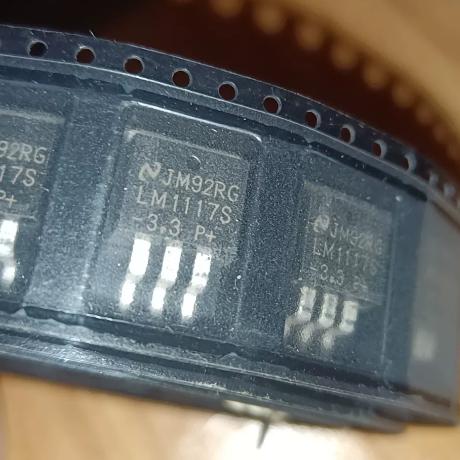
The LM1117S-3.3 is one of the most widely used low-dropout (LDO) voltage regulators in the electronics industry, providing a fixed 3.3 V output at up to 1 A from a higher input voltage. It is the de facto standard 3.3 V regulator for embedded systems, IoT devices, Arduino shields, and virtually any circuit that needs a 3.3 V rail from a 5 V or higher supply.
The LM1117 family was originally introduced by National Semiconductor (now part of TI) as an improved replacement for the older LM317 adjustable regulator in fixed-voltage applications. The key improvement is the lower dropout voltage: 1.2 V typical at 1 A for the LM1117 versus 2-3 V for the LM317. This means the LM1117S-3.3 can regulate 3.3 V from an input as low as 4.5 V, while the LM317 would need at least 5.3 V.
The LM1117S-3.3 is a commodity part, widely second-sourced by dozens of manufacturers. The most common sources include HTC Korea TAEJIN Technology, Texas Instruments (TLV1117), ON Semiconductor (NCP1117), Diodes Incorporated (AZ1117), Advanced Monolithic Systems (AMS1117), and many others. While the basic specifications are similar across manufacturers, the exact dropout voltage, output accuracy, and stability requirements can vary slightly. Always consult the specific manufacturer’s datasheet.
The 3.3 V output voltage is by far the most popular variant, driven by the ubiquitous use of 3.3 V logic in modern digital ICs, microcontrollers, and wireless modules. The LM1117 family also offers fixed output voltages of 1.2 V, 1.5 V, 1.8 V, 2.5 V, and 5.0 V, plus an adjustable version (LM1117S-ADJ) that uses an external resistor divider to set any output voltage from 1.25 V to 13.8 V.
The SOT-223-3 package is the most common package for the LM1117. It is a surface-mount package with three pins (GND/ADJ, VOUT, VIN) plus a large tab that is electrically connected to pin 2 (VOUT) and serves as a heat sink. The tab must be soldered to a copper pad on the PCB for proper heat dissipation. The thermal resistance from junction to ambient is approximately 130 degrees C/W with minimal PCB copper, but can be reduced to 50-80 degrees C/W with a large copper area under the tab.
The LM1117 requires an output capacitor of at least 10 uF for stability. Unlike newer LDO regulators that are stable with ceramic capacitors, the LM1117 was designed for tantalum or aluminum electrolytic capacitors with higher ESR. Using low-ESR ceramic capacitors can cause instability (oscillation) unless a series resistor is added to simulate the ESR. Many modern designs use a 10 uF tantalum or a 22 uF ceramic with a 1 Ohm series resistor.
At $0.09 per unit in volume, the LM1117S-3.3 is one of the most cost-effective ways to generate a 3.3 V rail. However, designers should be aware of its limitations: relatively high quiescent current (5 mA), high dropout voltage (1.2 V), and limited PSRR (75 dB). For battery-powered or noise-sensitive applications, newer LDO regulators such as the TLV1117LV33, AP2112, or RT9013 offer lower Iq, lower dropout, and better noise performance at a slightly higher cost.





 English
  简体中文
简体中文  Español
  العربية