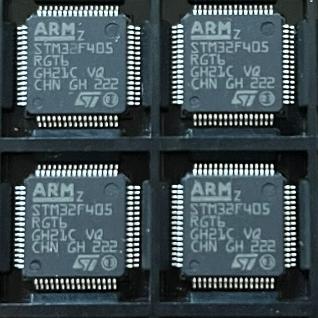
The STM32F405RGT6 operates as a high-performance embedded microcontroller with the following subsystem architecture:
1. Cortex-M4 Core with FPU: The 32-bit ARM Cortex-M4 CPU executes at up to 168 MHz with single-precision floating-point unit (FPU) and DSP instruction set. The ART Accelerator caches Flash instructions and branch targets to achieve 0-wait-state execution, delivering 210 DMIPS. An MPU (Memory Protection Unit) provides memory access control for OS-level security.
2. Memory Subsystem: 1 MB Flash with ART Accelerator prefetch, 192 KB SRAM (128 KB main + 64 KB CCM RAM directly coupled to core for deterministic access), 4 KB backup SRAM (VBAT-domain), and 512 bytes OTP. An FSMC (Flexible Static Memory Controller) supports external CF, SRAM, PSRAM, NOR, and NAND memories.
3. Clock and Power Management: Multi-clock source system (4-26 MHz HSE, 16 MHz HSI RC, 32 kHz LSE, 32 kHz LSI) with PLL generating system clocks. Power modes include Run, Sleep, Stop, and Standby. A PVD (Programmable Voltage Detector) monitors supply voltage. VBAT pin powers RTC and backup domain when main supply is absent.
4. Analog Subsystem: Three independent 12-bit ADCs (2.4 MSPS each, 7.2 MSPS triple-interleaved) with up to 24 channels, dual sample-and-hold, and temperature sensor. Two 12-bit DACs for analog output. All analog modules share dedicated VDDA/VSSA supply pins for noise isolation.
5. Timer Subsystem: Up to 17 timers including twelve 16-bit general-purpose timers, two 32-bit timers (up to 168 MHz), two PWM timers for motor control with dead-time generation, two watchdog timers (IWDG, WWDG), and SysTick.
6. Communication Subsystem: Multi-bus matrix connecting APB1 (42 MHz), APB2 (84 MHz), and AHB (168 MHz) domains. Peripherals include 3x I2C, 4x USART + 2x UART, 3x SPI/I2S, 2x CAN, SDIO, USB FS/HS OTG, and Ethernet MAC with DMA and IEEE 1588v2 hardware timestamping.
7. DMA Subsystem: Two DMA controllers with 16 total streams, each with FIFO and burst support, enabling peripheral-to-memory, memory-to-peripheral, and memory-to-memory transfers without CPU intervention.




 English
  简体中文
简体中文  Español
  العربية