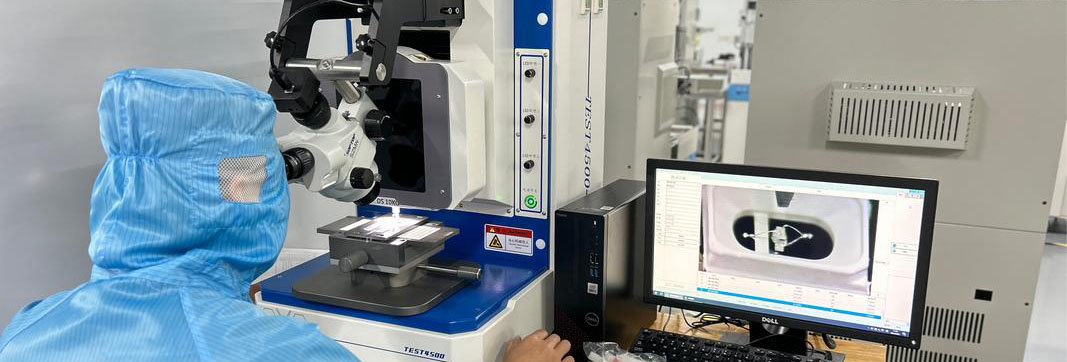
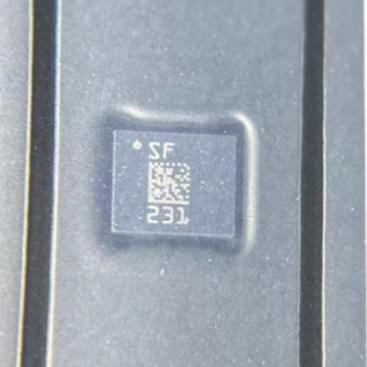
The LSM6DSLTR operates as a dual MEMS inertial sensor combining a capacitive 3-axis accelerometer and a capacitive 3-axis gyroscope with integrated signal conditioning and digital processing.
Accelerometer Sensing Mechanism: The accelerometer uses a differential capacitive sensing principle. Each axis has a proof mass suspended by silicon springs. When acceleration is applied, the proof mass displaces relative to fixed electrodes, changing the differential capacitance. The capacitance change is proportional to the applied acceleration and is converted to a digital value by a sigma-delta ADC. The 16-bit output provides high resolution across all selectable full-scale ranges (±2/±4/±8/±16 g). The sensitivity scales with the full-scale setting: 0.061 mg/LSB at ±2 g, 0.122 mg/LSB at ±4 g, 0.244 mg/LSB at ±8 g, and 0.488 mg/LSB at ±16 g. The accelerometer bandwidth and ODR (output data rate) are independently programmable from 1.6 Hz to 6.66 kHz.
Gyroscope Sensing Mechanism: The gyroscope uses a vibrating MEMS structure operating on the Coriolis effect principle. A proof mass is driven to vibrate at a resonant frequency. When angular rate is applied, the Coriolis force causes a displacement perpendicular to both the drive vibration and the rotation axis. This displacement is detected capacitively and converted to a digital angular rate measurement. The 16-bit output provides selectable full-scale ranges from ±125 to ±2000 dps with sensitivity from 4.375 mdps/LSB (±125 dps) to 70 mdps/LSB (±2000 dps). The gyroscope ODR is independently programmable from 1.6 Hz to 6.66 kHz.
Power Mode Architecture: The LSM6DSLTR supports multiple power modes for each sensor independently. The accelerometer has four modes: Power-down, Low-power (reduced bandwidth, lowest current), Normal (standard performance), and High-performance (highest bandwidth, best noise). The gyroscope has three modes: Power-down, Normal, and High-performance (also called sleep-to-wakeup mode). In combo high-performance mode with both sensors active, total supply current is 0.65 mA. In low-power accelerometer-only mode at 12.5 Hz ODR, current is approximately 10 µA.
Smart FIFO: The 4 KB FIFO buffer accumulates sensor data (acceleration, angular rate, temperature, timestamp) without requiring frequent host reads. In dynamic mode, the FIFO can be configured to accumulate data only when a specific event (e.g., significant motion) occurs, or to switch from bypass to FIFO mode upon a trigger. The FIFO supports watermark interrupts, overrun detection, and decimation (storing every Nth sample) to optimize buffer utilization.
Embedded Processing Functions: The pedometer uses accelerometer data to detect steps via peak-detection algorithms running in the sensor hardware. The step counter accumulates total steps. Significant motion detection identifies when the device transitions from stationary to mobile, enabling location-based services. The tilt function detects device orientation changes. All these functions operate autonomously, generating interrupts without host CPU intervention.
Sensor Synchronization: The LSM6DSLTR provides hardware timestamping and a data synchronization signal that can be routed to an external pin. This feature allows precise time-alignment of IMU data with external sensors (e.g., magnetometer, barometer) for sensor fusion algorithms, critical for applications like indoor navigation and augmented reality.
Hard/Soft Iron Correction: The device includes registers for hard-iron and soft-iron offset correction values that are applied to the gyroscope output when fusing with an external magnetometer. This simplifies the host software burden for 9DoF sensor fusion implementations.





 English
  简体中文
简体中文  Español
  العربية