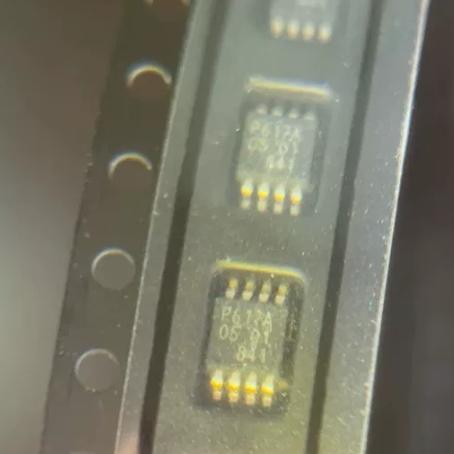
The PCA9617A is an I2C-bus repeater from NXP that provides both voltage level translation and bus capacitance isolation between two I2C bus segments. The PCA9617ADP is the TSSOP-8 packaged version, which is a footprint and functional replacement for the PCA9517A at Fast-mode speeds, with the added benefit of Fast-mode Plus (1 MHz) support.
The device has two ports with different voltage and signaling characteristics. Port A operates from 0.8 V to 5.5 V with normal CMOS logic levels — its output pulls down to near 0 V (hard low) and its input threshold is 0.35 × VCC(A). Port B operates from 2.2 V to 5.5 V with a static offset of approximately 0.55 V — its output pulls down to only 0.55 V, and its input threshold is about 0.45 V. The offset design prevents latch-up: when Port B internally drives low at 0.55 V, its own input (threshold 0.45 V) does not recognize this as a valid low, preventing the device from holding itself in a low state.
The key benefit of the PCA9617A is bus capacitance isolation. Each port of the repeater presents only about 7 pF of capacitance to its respective bus, regardless of the capacitance on the other side. This allows system designers to create large I2C networks well beyond the 400-pF specification limit. At 1 MHz (Fm+), each side can support up to 540 pF; at lower speeds, each side can support up to 4000 pF.
The level translation works in both directions without direction pins — the open-drain I2C bus architecture inherently supports this. A low on Port A (below 0.3 × VCC(A)) turns on the Port B pull-down. A low on Port B (below 0.4 V) turns on the Port A pull-down. This bidirectional operation is transparent to the I2C protocol, including arbitration, clock stretching, and multi-master scenarios.
The EN (enable) pin is active-high, referenced to VCC(B). When EN is low, both port drivers are disabled and all I/O pins are high-impedance. The device is enabled only when VCC(A) > 0.8 V and VCC(B) > 2.2 V, with a ~400 µs power-up delay for internal reference settling.
The PCA9617A is included in NXP’s 15-year product longevity program, making it suitable for long-lifecycle industrial and automotive applications.





 English
  简体中文
简体中文  Español
  العربية