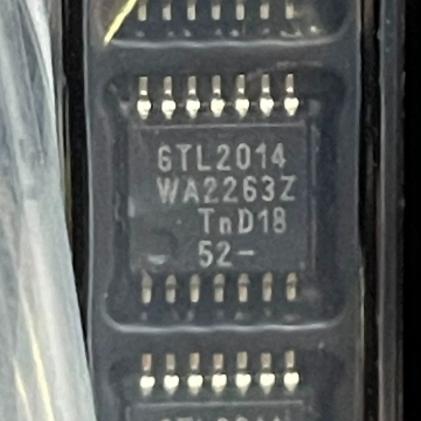
GTL2014PW


4-bit LVTTL-to-GTL transceiver, 3.0-3.6V, 5V-tolerant inputs, adjustable Vref, DIR pin, TSSOP-14, -40~85°C

3000

Effective Inventory
Go to Inquiry

Image for reference only

Manufacturer Part:

GTL2014PW

Package:

TSSOP-14 (SOT402-1) (5.0 x 4.4 x 1.1 mm, 0.65mm pitch)

Brand:
Product Categories:
Other recommendations you may be interested in.
Description

The GTL2014PW from NXP Semiconductors is a 4-bit LVTTL-to-GTL translating transceiver in a 14-pin TSSOP package (5.0 x 4.4 mm). It operates from a single 3.0 V to 3.6 V supply with 4 mA typical supply current. The LVTTL A-port inputs are 5.5 V tolerant, and the GTL B-port I/Os operate up to 3.6 V with open-drain outputs. A direction pin (DIR) configures the device as either a GTL-to-LVTTL sampling receiver or an LVTTL-to-GTL driver. VREF is adjustable from 0.5 V to VCC/2 for GTL threshold reference. The device supports partial power-down and provides ESD protection exceeding 2000 V HBM. Operating temperature range is -40°C to +85°C.

The GTL2014PW is a 4-bit translating transceiver from NXP designed to interface 3.3-V LVTTL logic with GTL (Gunning Transceiver Logic) buses commonly found in processor and memory controller applications. The device is pin-to-pin backward compatible with the GTL2005, with improved VREF tracking down to 0.5 V for low-voltage CPU interfaces.

GTL is an open-drain signaling standard that uses a reference voltage (VREF) to set the switching threshold. GTL signals swing between 0 V (low) and a termination voltage (VTT), typically 1.2 V or 1.5 V, with VREF at approximately VTT/2. This lower voltage swing compared to LVTTL enables faster edge rates and lower power dissipation at high frequencies, making GTL popular for processor front-side buses and high-speed memory interfaces.

The GTL2014 provides 4 bits of bidirectional level translation. When DIR is high, the device translates from LVTTL (A port) to GTL (B port) — the LVTTL inputs drive the GTL open-drain outputs. When DIR is low, the device translates from GTL (B port) to LVTTL (A port) — the GTL inputs are sampled against VREF and the results appear on the LVTTL outputs.

The A-port LVTTL inputs tolerate up to 5.5 V, allowing direct connection to 5-V CMOS or TTL logic. The B-port GTL I/Os are open-drain and tolerate up to 3.6 V, suitable for both standard GTL (VTT = 1.2 V) and GTL+ (VTT = 1.5 V) buses. The VREF pin accepts a reference voltage from 0.5 V to VCC/2 (1.8 V max at VCC = 3.6 V), accommodating modern low-voltage processors.

The GTL2014 is backward compatible with the GTL2005, though the A and B port labels are interchanged between the two devices. Designers migrating from GTL2005 should note this pin swap. The GTL2014’s improved VREF linearity below 0.8 V and slightly longer propagation delays distinguish it from the GTL2005.

**GTL Signaling Interface:** GTL uses open-drain drivers with a resistive pull-up to VTT (typically 1.2 V or 1.5 V). The receiver compares the GTL bus voltage against VREF (approximately VTT/2) to determine the logic level. When the driver pulls the bus below VREF, the receiver detects a low. When the driver releases, the pull-up resistor pulls the bus above VREF, and the receiver detects a high.

**Direction Control (DIR Pin):** When DIR is high, the A-port LVTTL inputs drive the B-port GTL open-drain outputs. A high on an A-port input causes the corresponding B-port output to pull down (assert low on GTL bus); a low on the A-port input releases the B-port output (GTL bus pulled high by external termination). When DIR is low, the B-port GTL inputs are compared against VREF, and the results drive the A-port LVTTL push-pull outputs.

**VREF Reference:** The VREF pin establishes the switching threshold for the GTL receivers. It must be connected to a clean reference voltage, typically derived from VTT through a resistor divider. The GTL2014’s VREF tracks accurately down to 0.5 V, supporting low-voltage CPU cores.

**Partial Power-Down:** The I/O pins are designed to tolerate voltages when VCC is not applied, preventing backflow current damage in hot-swap and power-sequencing scenarios.

Pin Name Type Description
1 1A I/O LVTTL I/O bit 0; 5.5V tolerant input; push-pull output when DIR=low (GTL-to-LVTTL)
2 2A I/O LVTTL I/O bit 1; same characteristics as 1A
3 3A I/O LVTTL I/O bit 2
4 4A I/O LVTTL I/O bit 3
5 DIR I Direction control; HIGH = LVTTL-to-GTL (A drives B); LOW = GTL-to-LVTTL (B drives A); do not change while bus is active
6 GND G Ground
7 VREF I GTL reference voltage input; 0.5V to VCC/2; sets receiver threshold; connect to clean reference derived from VTT
8 1B I/O GTL I/O bit 0; open-drain output; 3.6V tolerant; compared against VREF when receiving
9 2B I/O GTL I/O bit 1
10 3B I/O GTL I/O bit 2
11 4B I/O GTL I/O bit 3
12-14 GND/NC G/- Ground / no connect
Application Description
Processor Front-Side Bus Interface Connect 3.3V LVTTL chipset logic to GTL/GTL+ processor bus; DIR pin controlled by chipset; VREF set to VTT/2 (0.65V for GTL+); 4 bits cover address/data lines; use multiple devices for wider buses
Memory Controller GTL Bus Translate between 3.3V memory controller and GTL-terminated DRAM bus; open-drain B-port drives GTL termination resistors; VREF derived from VTT supply; direction pin switches between read/write cycles
Model Manufacturer Compatibility Key Difference
GTL2005PW NXP Legacy Predecessor 4-bit LVTTL-to-GTL transceiver; same TSSOP-14 footprint; A/B port labels swapped vs GTL2014; VREF degrades below 0.8V; shorter propagation delay; use only for legacy drop-in replacement
GTL2010PW NXP Series Variant (2-bit) 2-bit LVTTL-to-GTL transceiver; smaller TSSOP-8 package; same electrical characteristics; use for narrower GTL buses
SN74GTL2014PWR TI Functional Equivalent 4-bit LVTTL-to-GTL transceiver; TSSOP-14; similar specs; TI-sourced alternative; verify pinout compatibility before substituting
Recommend Parts
Gauge pressure sensor, 0-10kPa, 0.2-4.7V output, high sensitivity 450mV/kPa, 5V supply, single port

Brand:

Package:

SENSOR4F (17.78 x 29.48 x 10.67 mm, single side port)
In stock:
2620pcs

Cargo cycle: 3~7 Days
The minimum order is 1

Go to Inquiry
Gauge pressure sensor, 0-100kPa, 0.2-4.7V output, on-chip conditioned, 5V supply, single port

Brand:

Package:

SENSOR4F (17.78 x 29.48 x 10.67 mm, single side port)
In stock:
7645pcs

Cargo cycle: 3~7 Days
The minimum order is 1

Go to Inquiry
Absolute pressure sensor, 15-700kPa, 0.2-4.7V output, vacuum referenced, 5V supply, single port

Brand:

Package:

SENSOR4F (17.78 x 29.48 x 10.67 mm, single side port)
In stock:
6161pcs

Cargo cycle: 3~7 Days
The minimum order is 1

Go to Inquiry
Gauge pressure sensor, 15-700kPa, 0.2-4.7V output, on-chip conditioned, 5V supply, single port

Brand:

Package:

SENSOR4F (17.78 x 29.48 x 10.67 mm, single side port)
In stock:
7585pcs

Cargo cycle: 3~7 Days
The minimum order is 1

Go to Inquiry
Differential pressure sensor, 0-700kPa, 0.2-4.7V output, on-chip conditioned, 5V supply, dual port

Brand:

Package:

SENSOR4F (17.78 x 29.48 x 10.67 mm, dual side ports)
In stock:
9760pcs

Cargo cycle: 3~7 Days
The minimum order is 1

Go to Inquiry
Differential pressure sensor, 0-100kPa, 0.2-4.7V output, on-chip conditioned, 5V supply, dual port

Brand:

Package:

SENSOR4F (17.78 x 29.48 x 10.67 mm, dual side ports)
In stock:
8488pcs

Cargo cycle: 3~7 Days
The minimum order is 1

Go to Inquiry
Quality Assurance

All electronic components we source from our partnered supply chains go through strict incoming inspections.Through careful testing, we ensure everything delivered to customers is genuine original parts and meets quality requirements.In addition, we keep complete inspection records to make the entire supply chain process clear and traceable.

Certification
We have obtained a number of professional certifications and built our own professional testing laboratory.This ensures that every product we deliver to our customers meets the highest quality requirements.We conduct tests in strict accordance with procedures to ensure stable product quality and accurate parameters.To guarantee genuine original parts, we also cooperate with reliable third-party testing institutions for strict quality inspection.We always attach great importance to quality and fully comply with industry standards, relevant regulations, and ISO 9001:2015 requirements.

Shipping & Payment

All electronic components we source from our partnered supply chains go through strict incoming inspections.Through careful testing, we ensure everything delivered to customers is genuine original parts and meets quality requirements.In addition, we keep complete inspection records to make the entire supply chain process clear and traceable.

Certification
We have obtained a number of professional certifications and built our own professional testing laboratory.This ensures that every product we deliver to our customers meets the highest quality requirements.We conduct tests in strict accordance with procedures to ensure stable product quality and accurate parameters.To guarantee genuine original parts, we also cooperate with reliable third-party testing institutions for strict quality inspection.We always attach great importance to quality and fully comply with industry standards, relevant regulations, and ISO 9001:2015 requirements.

Service & Packaging

All electronic components we source from our partnered supply chains go through strict incoming inspections.Through careful testing, we ensure everything delivered to customers is genuine original parts and meets quality requirements.In addition, we keep complete inspection records to make the entire supply chain process clear and traceable.

Certification
We have obtained a number of professional certifications and built our own professional testing laboratory.This ensures that every product we deliver to our customers meets the highest quality requirements.We conduct tests in strict accordance with procedures to ensure stable product quality and accurate parameters.To guarantee genuine original parts, we also cooperate with reliable third-party testing institutions for strict quality inspection.We always attach great importance to quality and fully comply with industry standards, relevant regulations, and ISO 9001:2015 requirements.