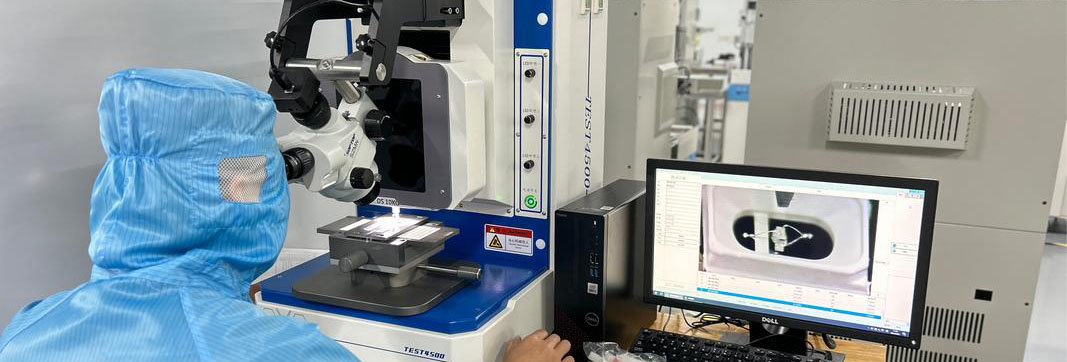
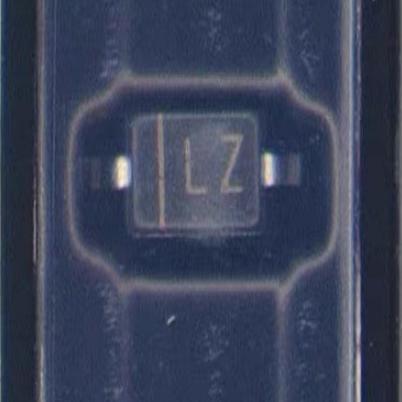
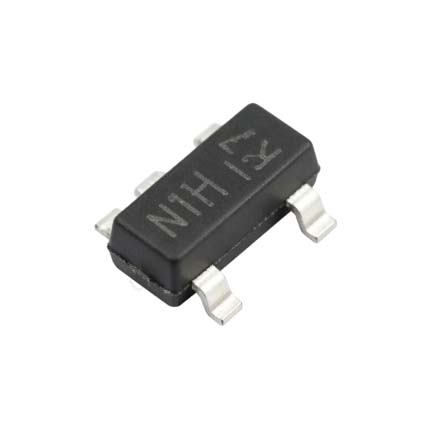
The BAT760-7 operates as a Schottky barrier rectifier, utilizing a metal-semiconductor (Schottky) junction rather than a conventional P-N junction.
Forward Conduction: When a forward bias voltage exceeding the barrier potential is applied (anode positive relative to cathode), majority carriers (electrons) cross the metal-semiconductor junction with minimal energy loss. The Schottky barrier height is inherently lower than a P-N junction turn-on voltage, resulting in the characteristically low forward voltage drop (245 mV typ at 10 mA). This low VF translates directly to lower power dissipation (P = VF × IF) compared to silicon P-N diodes, improving power conversion efficiency.
Reverse Blocking: Under reverse bias (cathode positive relative to anode), the Schottky junction blocks current flow. However, the metal-semiconductor junction has a lower breakdown voltage than a P-N junction of equivalent construction. The BAT760-7 is rated for 30 V reverse blocking, with a breakdown voltage guaranteed at 30 V minimum (IR = 500 μA). Reverse leakage current increases with temperature, which is a characteristic trade-off of Schottky construction.
Fast Switching: Because Schottky diodes are majority-carrier devices, there is no reverse recovery charge (Qrr) associated with minority carrier recombination. The switching speed is limited only by the junction capacitance (25 pF typ), enabling fast commutation without the reverse recovery current spike seen in P-N diodes. This makes the BAT760-7 ideal for high-frequency switching applications.
Surge Handling: During transient forward surge events (e.g., inrush current, hot-plug), the device can handle up to 5.5 A peak (8.3 ms single half sine-wave) without damage. The thermal mass of the junction absorbs the pulse energy, and the device returns to normal operation after the transient subsides, provided the junction temperature remains within rated limits.





 English
  简体中文
简体中文  Español
  العربية