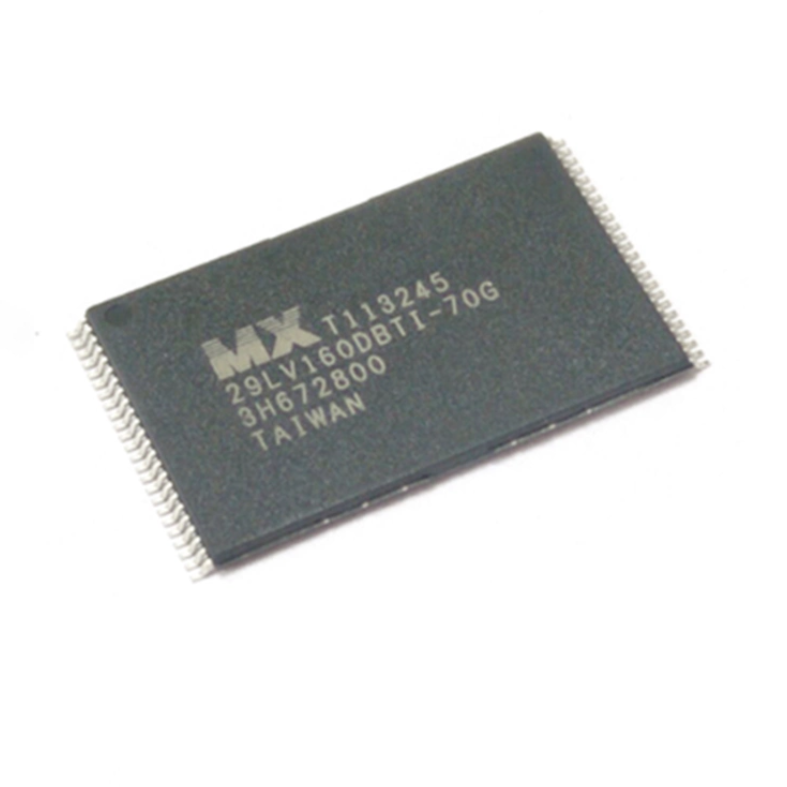
MX29LV160DBTI-70G


16Mbit parallel NOR Flash, 70 ns access, 2.7-3.6V, bottom-boot, TSOP-48

17800

Effective Inventory
Go to Inquiry

Image for reference only

Manufacturer Part:

MX29LV160DBTI-70G

Package:

48-TSOP (18.4 x 12.0 mm)

Brand:
Other recommendations you may be interested in.
Description

The MX29LV160DBTI-70G is a 16Mbit (2M x 8 / 1M x 16) parallel NOR Flash memory from Macronix International operating at 2.7-3.6V with 70 ns access time. It features bottom-boot block architecture (16K + 2x8K + 32K + 31x64K sectors), CFI compliance, sector protect/unprotect, erase suspend/resume, 256-byte OTP security zone, and x8/x16 bus width selection. Programming performance includes 9 μs byte program, 0.7 s sector erase, and 15 s chip erase times. Packaged in 48-TSOP (18.4 x 12.0 mm), it operates from -40°C to +85°C with RoHS3 and MSL-3 compliance.

The MX29LV160DBTI-70G is a 16Mbit (2M x 8 or 1M x 16) parallel NOR Flash memory device manufactured by Macronix International, belonging to the MX29LV series of 3V-only standard parallel NOR Flash products. The device operates from a single 2.7V to 3.6V supply voltage and provides a maximum random access time of 70 ns.

The memory is organized with an asymmetrical boot block architecture featuring 4 banks. The bottom-boot (B) variant places the smallest sectors at the lowest addresses. The sector architecture consists of 16 KB + 2 x 8 KB + 32 KB + 31 x 64 KB sectors, totaling 35 sectors. The device supports x8 (byte) and x16 (word) selectable bus widths via the BYTE# pin.

Key features include CFI (Common Flash Interface) compliance, sector protect/unprotect capability, temporary sector unprotect, erase suspend/resume, hardware RESET# pin, write protect (WP#) pin, and an optional 256-byte OTP security region. Programming performance includes byte program time of 9 μs typical, word program time of 11 μs typical, sector erase time of 0.7 s typical, and chip erase time of 15 s typical.

The device is packaged in a 48-pin TSOP (18.4 x 12.0 mm) and operates over the industrial temperature range of -40°C to +85°C. It is RoHS3 compliant with MSL-3 (168 hours) rating.

The MX29LV160DBTI-70G is a parallel NOR Flash memory device that uses a standard command/address/data interface for read, program, and erase operations.

Read Operation: After power-up or reset, the device defaults to read mode. The host provides the address on the address bus (A0-A19 for word mode, A0-A19 with A-1 for byte mode) and asserts CE# and OE# low. Data appears on the data bus (DQ0-DQ15 in word mode, DQ0-DQ7 in byte mode) after the access time (70 ns max). The device supports random access reads without any command sequence.

Command Interface: All write operations (program, erase, configuration) use a command-driven protocol. Commands are written by driving specific data patterns to designated address sequences (e.g., 555h/AAAh for standard JEDEC command set). The command sequencer validates the command and initiates the requested operation.

Program Operation: To program a byte or word, the host issues a Program command sequence. The device internally generates the high voltage needed for Fowler-Nordheim tunneling, injecting charge into the floating gate of the selected cell. Program completion is indicated by the Data Polling bit (DQ7) or the Toggle bit (DQ6). Byte program time is 9 μs typical, word program time is 11 μs typical.

Erase Operation: Erase operations use Fowler-Nordheim tunneling in reverse, removing charge from floating gates. The device supports sector erase (4K/8K/32K/64K byte sectors), chip erase, and erase suspend/resume. Sector erase time is 0.7 s typical. During erase, the same Data Polling and Toggle bit mechanisms indicate completion.

CFI (Common Flash Interface): The device implements the CFI standard, allowing host software to discover device parameters (density, voltage, timing, sector layout) programmatically rather than hard-coding them. The CFI query is accessed via a specific command sequence.

Boot Block Architecture: The MX29LV160DB variant uses a bottom-boot architecture where the smallest sectors (16K + 2x8K + 32K) are located at the lowest addresses, suitable for processors that boot from address 0.

Pin Group Pin Name Type Default Function Description
A0-A19 A[19:0] I Address Inputs Address bus for row/column selection; A-1 is LSB in byte mode via DQ15/A-1
DQ0-DQ15 DQ[15:0] I/O Data Bus Bidirectional data bus; DQ8-DQ15 unused in byte mode
DQ15/A-1 DQ15/A-1 I/O/I Data MSB / Address LSB DQ15 in word mode; A-1 (LSB address) in byte mode
CE# Chip Enable I Chip Select (Active Low) Enables the device for read/write operations
OE# Output Enable I Output Enable (Active Low) Gates data onto the output bus during read operations
WE# Write Enable I Write Enable (Active Low) Controls write operations (command, address, data latching)
RESET# Hardware Reset I Reset (Active Low) Resets internal state machine; also used for temporary sector unprotect with VID
WP# Write Protect I Write Protect (Active Low) When low, prevents program/erase of the first and last sectors
BYTE# Bus Width Select I x8/x16 Mode Select Low = byte mode (x8); High = word mode (x16)
RY/BY# Ready/Busy O Status Output Low = device busy (program/erase in progress); High = ready
VCC Power P Power Supply 2.7V to 3.6V
VSS Ground G Ground Device ground
Application Description
Embedded System Boot Flash Stores bootloader and firmware for microcontrollers, DSPs, and application processors that execute code directly from parallel NOR Flash (XIP)
Industrial Control Systems Program storage in PLCs, motor drives, and HMI panels requiring reliable non-volatile storage with -40°C to 85°C industrial temperature support
Networking Equipment Firmware and configuration storage in routers, switches, and gateways; parallel interface provides fast boot-time access
Consumer Electronics Set-top box and digital TV firmware storage; CFI compliance simplifies driver development across multiple platforms
Automotive Systems ECU and infotainment firmware storage in automotive electronics requiring long-term data retention and reliable erase/program cycling
Model Manufacturer Compatibility Key Difference
S29AL016J70TFI020 Infineon (Spansion) Pin-Compatible 16Mb parallel NOR, same 48-TSOP pinout; virtually identical architecture; different manufacturer ID (01h vs C2h)
MX29LV160DBTI-55G Macronix Pin-Compatible Same device, 55 ns access time (faster); requires VCC = 3.0-3.6V (restricted range)
MX29LV160CTTI-70G Macronix Pin-Compatible Top-boot variant (boot block at highest address); same pinout and electrical specs
A29L160ATV-70F AMIC Technology Functionally Similar 16Mb parallel NOR, 48-TSOP; different manufacturer ID; verify CFI parameters
M29W160EB70N6E Infineon Functionally Similar 16Mb parallel NOR, 70 ns, 48-TSOP; different boot block organization; verify sector map compatibility
Recommend Parts
Quality Assurance

All electronic components we source from our partnered supply chains go through strict incoming inspections.Through careful testing, we ensure everything delivered to customers is genuine original parts and meets quality requirements.In addition, we keep complete inspection records to make the entire supply chain process clear and traceable.

Certification
We have obtained a number of professional certifications and built our own professional testing laboratory.This ensures that every product we deliver to our customers meets the highest quality requirements.We conduct tests in strict accordance with procedures to ensure stable product quality and accurate parameters.To guarantee genuine original parts, we also cooperate with reliable third-party testing institutions for strict quality inspection.We always attach great importance to quality and fully comply with industry standards, relevant regulations, and ISO 9001:2015 requirements.

Shipping & Payment

All electronic components we source from our partnered supply chains go through strict incoming inspections.Through careful testing, we ensure everything delivered to customers is genuine original parts and meets quality requirements.In addition, we keep complete inspection records to make the entire supply chain process clear and traceable.

Certification
We have obtained a number of professional certifications and built our own professional testing laboratory.This ensures that every product we deliver to our customers meets the highest quality requirements.We conduct tests in strict accordance with procedures to ensure stable product quality and accurate parameters.To guarantee genuine original parts, we also cooperate with reliable third-party testing institutions for strict quality inspection.We always attach great importance to quality and fully comply with industry standards, relevant regulations, and ISO 9001:2015 requirements.

Service & Packaging

All electronic components we source from our partnered supply chains go through strict incoming inspections.Through careful testing, we ensure everything delivered to customers is genuine original parts and meets quality requirements.In addition, we keep complete inspection records to make the entire supply chain process clear and traceable.

Certification
We have obtained a number of professional certifications and built our own professional testing laboratory.This ensures that every product we deliver to our customers meets the highest quality requirements.We conduct tests in strict accordance with procedures to ensure stable product quality and accurate parameters.To guarantee genuine original parts, we also cooperate with reliable third-party testing institutions for strict quality inspection.We always attach great importance to quality and fully comply with industry standards, relevant regulations, and ISO 9001:2015 requirements.