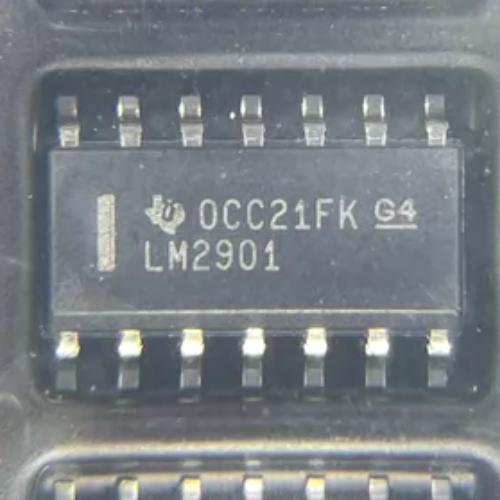
LM2901DR


Quad comparator, 2-30V, open-collector out, 1.3us prop delay, 7mV Vos, CM input includes GND, SOIC-14, -40~125C, tape&reel

80000

Effective Inventory
Go to Inquiry

Image for reference only

Manufacturer Part:

LM2901DR

Package:

SOIC-14 (D) (8.65 x 6.0 mm, 1.27mm pitch)

Brand:
Product Categories:
Other recommendations you may be interested in.
Description

The LM2901DR from Texas Instruments is a quad differential comparator operating from a single 2 V to 30 V supply in an SOIC-14 (D) package (8.65 x 6 mm). Key specifications: four independent voltage comparators; open-collector/open-drain output; 1.3 us typical propagation delay; input offset voltage 7 mV max at 25 degrees C; input bias current 250 nA max; common-mode input voltage range includes ground (0 V to 28.5 V); differential input voltage range equal to maximum-rated supply voltage plus or minus 38 V; low output saturation voltage; output compatible with TTL, MOS, and CMOS; quiescent current 0.2 mA per comparator typical; operating temperature -40 to +125 degrees C. The LM2901B is an upgraded drop-in replacement with 0.37 mV offset, 3.5 nA bias current, 1 us response time, and 38 V max supply. The D suffix denotes SOIC-14 package, R suffix denotes tape and reel. RoHS compliant.

The LM2901DR from Texas Instruments is the automotive/industrial-qualified version of the industry-standard LM339 quad differential comparator family. It contains four independent voltage comparators in a single SOIC-14 package, designed to operate from a single power supply over a wide voltage range of 2 V to 30 V without requiring a dual supply.

The LM2901 is one of the most widely used comparators in the electronics industry, alongside its commercial-grade sibling the LM339. The primary difference is the extended operating temperature range: the LM2901 is specified for -40 to +125 degrees C (automotive grade), while the LM339 is specified for 0 to +70 degrees C (commercial grade). The LM2901 also has slightly relaxed offset voltage and bias current specifications to account for the wider temperature range.

The open-collector output architecture is a defining feature. Each comparator output is an NPN transistor with an open collector, meaning the output can only pull low (sink current to ground) but cannot pull high. An external pull-up resistor is required to establish the high logic level. This has several advantages: (1) the output can be pulled up to a voltage different from the comparator supply (wired-OR logic); (2) multiple open-collector outputs can be connected together to implement AND or NOR logic without additional gates; (3) the output can directly drive loads such as LEDs, relays, or optocouplers.

The common-mode input voltage range that includes ground (0 V) is critical for single-supply applications. Many comparators require the inputs to be at least 1-2 V above the negative rail, but the LM2901 allows both inputs to go to ground (or even slightly below) without phase inversion or output glitches. This makes it ideal for low-side current sensing, battery monitoring, and zero-crossing detection applications where the input signal may be near ground.

The differential input voltage range of plus or minus 38 V (for the B-version) exceeds the supply voltage range, meaning the two inputs can differ by up to 38 V without damaging the device. This is useful for comparing signals from different voltage domains, such as monitoring a 24 V industrial signal with a 5 V comparator supply.

TI offers the LM2901B as an upgraded drop-in replacement with significantly improved specifications: offset voltage reduced from 7 mV to 0.37 mV (19x improvement), input bias current from 250 nA to 3.5 nA (71x improvement), propagation delay from 1.3 us to 1 us, and ESD rating from 500 V to 2 kV HBM. For new designs, TI recommends the B-version. However, the original LM2901 remains in high-volume production due to its extremely low cost and established design heritage.

The LM2901DR is available in SOIC-14 with tape and reel packaging (R suffix), suitable for automated SMT assembly. Other package options include PDIP-14 (N suffix), TSSOP-14 (PW suffix), and SOP-14 (NS suffix).

The LM2901DR operates as four independent differential voltage comparators sharing a common power supply and ground.

Comparator Operation: Each comparator has two inputs (IN+ and IN-) and one open-collector output. The comparator continuously compares the voltage at the non-inverting input (IN+) with the voltage at the inverting input (IN-). When V(IN+) is greater than V(IN-) by at least the offset voltage plus the overdrive voltage, the output transistor is off (open collector), and the output is pulled high by an external pull-up resistor. When V(IN+) is less than V(IN-), the output transistor turns on, pulling the output low (saturating to near ground). The output state changes when the differential input voltage crosses the switching threshold, which is ideally zero but is affected by the input offset voltage (up to 7 mV).

Open-Collector Output: The output stage consists of an NPN transistor with its collector connected to the output pin and its emitter connected to ground. When the comparator detects that IN+ is less than IN-, the output transistor saturates, pulling the output pin toward ground (typically 0.25 V at 4 mA sink current). When IN+ is greater than IN-, the output transistor is off, and the output pin floats (high impedance). An external pull-up resistor (typically 1 kOhm to 100 kOhm) connected from the output pin to the logic supply voltage establishes the high logic level. The pull-up voltage can be different from the comparator supply voltage, allowing level shifting.

Input Stage: The input stage uses a PNP differential pair that allows the common-mode input voltage range to extend down to ground (0 V) and up to VCC – 1.5 V. The PNP input transistors source a small bias current (typically 25 nA, max 250 nA) that flows out of the input pins. This bias current must be considered when designing high-impedance input networks, as it can create voltage offsets across source resistances. The differential input voltage is clamped by back-to-back diodes in parallel with a 1 kOhm resistor, limiting the differential current to safe levels even when the input voltage difference exceeds the supply voltage.

Propagation Delay: The typical propagation delay is 1.3 us for a 100 mV input step with 5 mV overdrive. This is relatively slow compared to dedicated high-speed comparators (which can be 10-100 ns), but is adequate for most control and monitoring applications. The propagation delay increases with smaller overdrive voltages and larger load capacitances.

Wired-OR Configuration: Multiple open-collector outputs can be connected together to a single pull-up resistor to implement a wired-OR (actually wired-AND) function. If any comparator output is low, the combined output is low. This is useful for creating multi-channel window comparators or multi-input alarm circuits without additional logic gates.

Power Supply: The LM2901 operates from a single supply (VCC to GND) without requiring a negative supply. The quiescent current is approximately 0.8 mA total (0.2 mA per comparator) and is relatively independent of supply voltage. The comparators remain functional down to 2 V supply, making them suitable for battery-powered applications.

Pin Name Type Description
1 OUT2 Output Comparator 2 open-collector output; pulls low (saturates to ground) when IN2- is greater than IN2+; floats high-impedance when IN2+ is greater than IN2-; requires external pull-up resistor to establish high logic level; can be pulled up to any voltage up to 30 V (independent of VCC); can sink up to 16 mA continuous; saturation voltage typically 0.25 V at 4 mA
2 OUT1 Output Comparator 1 open-collector output; same characteristics as OUT2; can be wire-ORed with other outputs
3 VCC Power Positive supply voltage; 2 V to 30 V; bypass with 100 nF ceramic capacitor to GND; quiescent current approximately 0.8 mA total for all four comparators; current does not vary significantly with supply voltage
4 IN1- Input Comparator 1 inverting input; common-mode voltage range 0 V to VCC-1.5 V; input bias current typically 25 nA flowing out of the pin; differential input voltage range plus or minus 38 V (B-version); this pin sets the reference voltage for comparator 1
5 IN1+ Input Comparator 1 non-inverting input; same voltage range and bias current as IN1-; when IN1+ voltage exceeds IN1- voltage, the output is high (open circuit)
6 IN2- Input Comparator 2 inverting input; same characteristics as IN1-; independent of comparator 1
7 IN2+ Input Comparator 2 non-inverting input; same characteristics as IN1+
8 IN3- Input Comparator 3 inverting input; same characteristics as IN1-
9 IN3+ Input Comparator 3 non-inverting input; same characteristics as IN1+
10 IN4- Input Comparator 4 inverting input; same characteristics as IN1-
11 IN4+ Input Comparator 4 non-inverting input; same characteristics as IN1+
12 GND Ground Ground; the negative supply rail; the common-mode input range includes this voltage (0 V); all output transistors sink current to this pin; connect to PCB ground plane
13 OUT4 Output Comparator 4 open-collector output; same characteristics as OUT2
14 OUT3 Output Comparator 3 open-collector output; same characteristics as OUT2
Application Description
Battery Low-Voltage Detector Use one comparator to monitor battery voltage against a reference set by a voltage divider and zener; open-collector output drives LED indicator or MCU interrupt; common-mode range includes ground for low-side monitoring; wide supply range (2-30 V) allows direct operation from the battery; 125 degrees C rated for under-hood automotive use
Window Comparator Use two comparators to create a window detector: one detects overvoltage (IN+ above upper threshold) and one detects undervoltage (IN+ below lower threshold); wire-OR the open-collector outputs to create a single fault output that is low when the input is outside the acceptable window; ideal for power supply monitoring
Zero-Crossing Detector Detect when an AC signal crosses zero volts; one comparator with IN- at ground and IN+ connected to the AC signal through a current-limiting resistor; output transitions at each zero crossing; useful for TRIAC/SSR firing angle control, dimmer circuits, and frequency measurement
Motor Overcurrent Protection Compare current-sense amplifier output against a reference voltage; when the motor current exceeds the threshold, the comparator output drives a shutdown signal; open-collector output can drive MOSFET gate or enable pin directly; fast 1.3 us response time enables rapid fault detection
Thermostat / Temperature Control Compare NTC thermistor voltage divider output against a setpoint reference; one comparator for heating (turn on when below setpoint) and one for cooling (turn on when above setpoint); open-collector outputs drive relay drivers or TRIAC optocouplers; hysteresis added with feedback resistor
Model Manufacturer Compatibility Key Difference
LM2901BDR TI Drop-in Upgrade Same pinout and package; improved specifications: 0.37 mV offset (vs 7 mV), 3.5 nA bias (vs 250 nA), 1 us response (vs 1.3 us), 2 kV ESD (vs 500 V), 38 V max (vs 30 V); recommended for new designs; slightly higher cost
LM339DR TI Pin-Compatible, Commercial Same quad comparator in SOIC-14; commercial temperature range 0 to 70 degrees C (vs -40 to 125 C); lower offset voltage 2 mV typical; use when extended temperature is not needed and lower offset is desired
LM393DR TI Dual Version Dual (not quad) comparator in SOIC-8; same comparator architecture; two comparators instead of four; smaller package; use when only two comparators are needed and board space is limited
TL331BDBVR TI Single Version Single B-version comparator in SOT-23-5; improved specifications; smallest footprint; use when only one comparator is needed and space is critical
TSX3704IDT ST Push-Pull Alternative Quad comparator with push-pull CMOS output (no pull-up resistor needed); rail-to-rail input; 2.7-16 V supply; faster response time; use when open-collector is not needed and simpler output is preferred
Recommend Parts
PMIC for AM335x, 3 bucks, 2 LDOs, battery charger, WLED, I2C, VQFN-48

Brand:

Package:

VQFN-48 (6×6 mm, 0.4 mm pitch)
In stock:
8909pcs

Cargo cycle: 3~7 Days
The minimum order is 1

Go to Inquiry
Octal D-type flip-flop, edge-triggered, async clear, 28MHz, SOP-20

Brand:

Package:

SOP-20 (NS) (12.6×7.8 mm)
In stock:
8359pcs

Cargo cycle: 3~7 Days
The minimum order is 1

Go to Inquiry
3-to-8 decoder/demux, active-low outputs, 3 enable inputs, 15ns, PDIP-16

Brand:

Package:

PDIP-16 (24.33×9.4 mm, Through-Hole)
In stock:
11952pcs

Cargo cycle: 3~7 Days
The minimum order is 1

Go to Inquiry
2W mono Class-AB audio amp, BTL speaker + SE headphone, 2.5-5.5V, HVSSOP-8

Brand:

Package:

HVSSOP-8 (DGN) (3.0×4.9 mm, PowerPAD)
In stock:
3337pcs

Cargo cycle: 3~7 Days
The minimum order is 1

Go to Inquiry
10/100 Ethernet PHY, MII/RMII/SNI, Auto-MDIX, 270mW, LQFP-48, commercial

Brand:

Package:

LQFP-48 (7×7 mm)
In stock:
14754pcs

Cargo cycle: 3~7 Days
The minimum order is 1

Go to Inquiry
Octal bus transceiver, 3-state outputs, 2-6V, 12ns tpd, TSSOP-20

Brand:

Package:

TSSOP-20 (6.5×6.4 mm)
In stock:
2638pcs

Cargo cycle: 3~7 Days
The minimum order is 1

Go to Inquiry
Quality Assurance

All electronic components we source from our partnered supply chains go through strict incoming inspections.Through careful testing, we ensure everything delivered to customers is genuine original parts and meets quality requirements.In addition, we keep complete inspection records to make the entire supply chain process clear and traceable.

Certification
We have obtained a number of professional certifications and built our own professional testing laboratory.This ensures that every product we deliver to our customers meets the highest quality requirements.We conduct tests in strict accordance with procedures to ensure stable product quality and accurate parameters.To guarantee genuine original parts, we also cooperate with reliable third-party testing institutions for strict quality inspection.We always attach great importance to quality and fully comply with industry standards, relevant regulations, and ISO 9001:2015 requirements.

Shipping & Payment

All electronic components we source from our partnered supply chains go through strict incoming inspections.Through careful testing, we ensure everything delivered to customers is genuine original parts and meets quality requirements.In addition, we keep complete inspection records to make the entire supply chain process clear and traceable.

Certification
We have obtained a number of professional certifications and built our own professional testing laboratory.This ensures that every product we deliver to our customers meets the highest quality requirements.We conduct tests in strict accordance with procedures to ensure stable product quality and accurate parameters.To guarantee genuine original parts, we also cooperate with reliable third-party testing institutions for strict quality inspection.We always attach great importance to quality and fully comply with industry standards, relevant regulations, and ISO 9001:2015 requirements.

Service & Packaging

All electronic components we source from our partnered supply chains go through strict incoming inspections.Through careful testing, we ensure everything delivered to customers is genuine original parts and meets quality requirements.In addition, we keep complete inspection records to make the entire supply chain process clear and traceable.

Certification
We have obtained a number of professional certifications and built our own professional testing laboratory.This ensures that every product we deliver to our customers meets the highest quality requirements.We conduct tests in strict accordance with procedures to ensure stable product quality and accurate parameters.To guarantee genuine original parts, we also cooperate with reliable third-party testing institutions for strict quality inspection.We always attach great importance to quality and fully comply with industry standards, relevant regulations, and ISO 9001:2015 requirements.