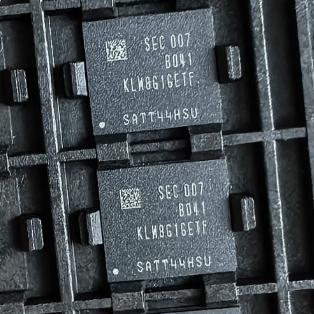
The KLM8G1GETF-B041 operates as a managed NAND flash storage device with the following architecture:
1. eMMC Protocol Interface: The host communicates via a standard MMC command set (CMD0-CMD62) over an 8-bit parallel data bus (DAT0-DAT7), a command line (CMD), and a clock line (CLK). In HS400 mode, an additional Data Strobe signal from the device synchronizes read data and CRC status, enabling DDR operation at 200 MHz for 400 MB/s bandwidth.
2. Integrated Flash Controller: The on-chip MMC controller manages all NAND flash operations transparently. It implements a Flash Translation Layer (FTL) that maps logical block addresses (LBAs) from the host to physical NAND pages, handling wear leveling, bad block remapping, ECC encoding/decoding, and garbage collection without host intervention.
3. NAND Flash Array: The internal 3D TLC (Triple-Level Cell) NAND stores 3 bits per cell for high density. The controller manages program/erase cycling and cell reliability through ECC (40-bit/1KB correction capability) and wear-leveling algorithms that distribute writes across the array to maximize endurance.
4. Partition Management: The device exposes three partition types. Boot Partitions (2 x 4 MB) support fast boot with configurable boot bus width and timing. The RPMB partition provides authenticated and replay-protected storage using HMAC-SHA256 for secure key and certificate storage. The User Area provides general-purpose storage accessible as a block device.
5. Dual Voltage Domains: VCC powers the NAND flash array at 3.3V, while VCCQ supplies the controller and I/O logic at either 1.8V or 3.3V, selected by the host. Independent power rails allow the host to power down VCC while maintaining VCCQ for low-power standby.
6. Speed Mode Negotiation: The device initializes in Legacy mode and the host negotiates higher speeds through EXT_CSD register writes. HS400 mode requires the host to first switch to HS200 (SDR), train timing, then switch to HS400 (DDR with strobe). The Data Strobe signal eliminates the need for host-side read data training.





 English
  简体中文
简体中文  Español
  العربية