DP83848CVVX


10/100Mbps Ethernet PHY, MII/RMII/SNI, Auto-MDIX, JTAG, 3.3V, 270mW, LQFP-48, 0~70C, PHYTER

10000

Effective Inventory
Go to Inquiry

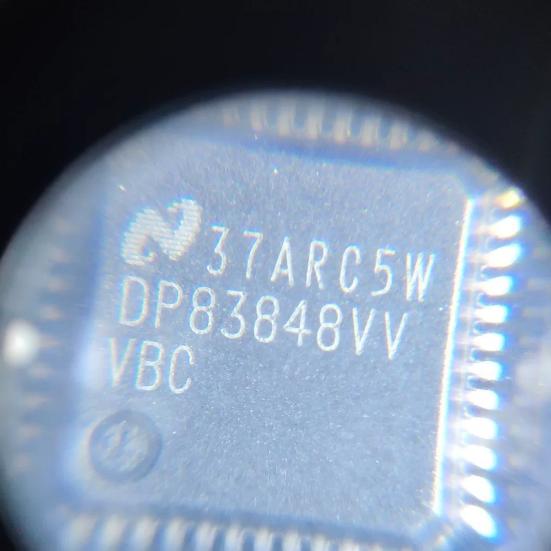
Image for reference only

Manufacturer Part:

DP83848CVVX

Package:

LQFP-48 PT (7 x 7 x 1.4 mm, 0.5mm pitch)

Brand:
Product Categories:
Other recommendations you may be interested in.
Description

The DP83848CVVX from Texas Instruments (formerly National Semiconductor) is a commercial-temperature single-port 10/100 Mbps Ethernet Physical Layer (PHY) transceiver in a 48-pin LQFP (7 x 7 x 1.4 mm) package with tape and reel packaging. Key specifications: IEEE 802.3 compliant (10BASE-T, 100BASE-TX); MII and RMII Rev. 1.2 MAC interfaces (configurable); SNI interface (configurable); MII serial management interface (MDC and MDIO); IEEE 802.3 auto-negotiation with parallel detection; Auto-MDIX for 10/100 Mbps; integrated ANSI X3.263 compliant TP-PMD with adaptive equalization and baseline wander compensation; 0.18 um CMOS technology; 3.3 V single supply; typical power consumption less than 270 mW; energy detection mode; 25 MHz clock output; IEEE 1149.1 JTAG boundary scan; error-free operation up to 137-150 meters CAT5; programmable LED support for link, 10/100 mode, activity, duplex, and collision detect; single register access for complete PHY status; 10/100 Mbps packet BIST (built-in self test); maximum supply current 92 mA typical; operating temperature 0 to +70 degrees C (commercial grade). The VVX suffix denotes LQFP-48 with tape and reel. Part of the PHYTER family. RoHS compliant. Active product status.

The DP83848CVVX from Texas Instruments is a member of the PHYTER family of 10/100 Mbps Ethernet PHY transceivers, designed for reliable Ethernet connectivity in commercial-temperature embedded applications. Originally developed by National Semiconductor (acquired by TI in 2011), the DP83848 series has been one of the most widely deployed 10/100 Ethernet PHYs in the embedded market for over two decades.

The DP83848CVVX is the commercial-temperature (0 to 70 degrees C) variant in LQFP-48 with tape and reel packaging. Other variants include the DP83848I (industrial, -40 to 85 degrees C) and DP83848VYB (extreme temperature, -40 to 105 degrees C). The VVX suffix specifically indicates the commercial-grade tape-and-reel version.

The DP83848 supports three MAC interface options: MII (Media Independent Interface), RMII (Reduced MII), and SNI (Serial Network Interface). The MII interface uses 16 signals (TXD[3:0], RXD[3:0], TX_CLK, RX_CLK, TX_EN, RX_DV, CRS, COL, MDC, MDIO) and is the most widely supported. The RMII interface reduces the pin count to 8 signals by using a 50 MHz reference clock and 2-bit data paths, simplifying PCB routing. The SNI interface provides a simple 4-bit nibble-wide interface for legacy designs. The interface mode is selected via hardware strap pins at power-up.

The Auto-MDIX feature automatically detects and corrects for straight-through or crossover cable connections, eliminating the need for dedicated MDI and MDI-X ports. This feature is supported at both 10 Mbps and 100 Mbps speeds with auto-negotiation, and also works with forced-speed modes.

The 25 MHz clock output is a valuable feature that eliminates the need for an external oscillator on the PCB. The DP83848 uses a single 25 MHz crystal connected to the X1 and X2 pins, and provides a buffered 25 MHz clock output on the CLK_OUT pin that can be used as the RMII reference clock for the MAC, reducing BOM cost and component count.

The energy detection mode (also called Intel Smart Power Down) reduces power consumption when the Ethernet link is down or the device is in an idle state. When enabled, the PHY enters a low-power state when no link partner is detected, reducing current consumption. The PHY automatically wakes up when a link partner is connected and auto-negotiation resumes.

The DP83848 is widely supported by embedded operating systems and network stacks. Linux kernel includes the natsemi driver for DP83848-based NICs, and the generic phylib supports DP83848 when used with MAC controllers that use the of_mdio framework. FreeRTOS and Zephyr RTOS also provide network stack support for DP83848-based designs.

The DP83848CVVX is commonly paired with microcontrollers that have an embedded Ethernet MAC, such as the NXP LPC1768, STMicroelectronics STM32F107/STM32F4x7, TI TM4C129x, and Microchip SAM7X/SAM9X. It is also used with FPGA-based Ethernet MACs and standalone Ethernet controllers (ENC28J60 alternative at higher performance).

At $2.51 per unit in volume (1000+), the DP83848CVVX is one of the most cost-effective 10/100 Ethernet PHY solutions available. When combined with a microcontroller that has an embedded MAC, the total Ethernet interface cost can be under $5 (PHY plus magnetics plus RJ-45), making it practical for cost-sensitive embedded networking applications.

The DP83848CVVX operates as the physical layer (PHY) transceiver in an Ethernet system, implementing the IEEE 802.3 physical layer functions to transmit and receive data over twisted-pair copper cable at 10 Mbps or 100 Mbps.

Physical Coding Sublayer (PCS): For 100BASE-TX, the PCS implements 4B/5B encoding (4 data bits encoded into 5-bit symbols) and scrambles the data to reduce EMI. The encoded data is serialized and transmitted as MLT-3 (Multi-Level Transmit) signals on the twisted pair, where each symbol represents one of three voltage levels. For 10BASE-T, the PCS implements Manchester encoding, where each bit is represented by a voltage transition (low-to-high for 1, high-to-low for 0).

Physical Medium Attachment (PMA): The PMA sublayer performs the analog front-end functions. On the transmit side, the digital data is converted to analog signals by the DAC and driven onto the twisted pair through the line driver. On the receive side, the analog signal from the cable is digitized by the ADC and processed by the adaptive equalizer to compensate for cable attenuation and distortion. The baseline wander compensator corrects for DC offset drift caused by AC coupling in the signal path.

Auto-Negotiation: The DP83848 implements IEEE 802.3u auto-negotiation, which automatically determines the highest common speed and duplex capability with the link partner. During auto-negotiation, the PHY exchanges Fast Link Pulse (FLP) bursts that advertise its capabilities (10/100 Mbps, half/full duplex, Auto-MDIX). The highest common denominator is selected: 100 Mbps full-duplex is preferred, followed by 100 Mbps half-duplex, 10 Mbps full-duplex, and 10 Mbps half-duplex. If the link partner does not support auto-negotiation, the parallel detection circuit detects the presence of 10BASE-T normal link pulses or 100BASE-TX idle signals and defaults to the appropriate speed in half-duplex mode.

Auto-MDIX: The Auto-MDIX feature automatically detects whether the connected cable is straight-through or crossover and internally swaps the transmit and receive pairs to ensure correct connectivity. This eliminates the need to stock both cable types and prevents connection failures due to wrong cable type. Auto-MDIX operates during auto-negotiation and also in forced-speed modes.

MII Interface: In MII mode, the DP83848 transfers data to and from the MAC using a nibble-wide (4-bit) data bus at 25 MHz for 100 Mbps or 2.5 MHz for 10 Mbps. The TX_CLK and RX_CLK signals provide timing reference. TX_EN indicates valid transmit data, RX_DV indicates valid receive data, CRS indicates carrier sense (activity on the medium), and COL indicates collision detection (half-duplex only).

RMII Interface: In RMII mode, the DP83848 uses a 2-bit data bus referenced to a 50 MHz clock, reducing the pin count from 16 (MII) to 8 (RMII). The 50 MHz reference clock is typically provided by the DP83848 CLK_OUT pin, or from an external oscillator. RMII is preferred for new designs due to the lower pin count and simplified PCB routing.

Serial Management Interface: The MDC/MDIO interface provides access to the DP83848 internal register set using the IEEE 802.3 Clause 22 protocol. The MAC controller can read and write PHY registers to configure operating modes, check link status, read PHY identification, enable energy detection, and access cable diagnostic features. The MDC clock frequency can be up to 25 MHz.

Energy Detection: When energy detection mode is enabled (via register bit), the DP83848 monitors the receive line for valid link pulses or data signals. If no activity is detected, the PHY enters a low-power state where most internal circuits are powered down. Periodically, the PHY wakes up briefly to check for link pulses. When a link partner is connected, the PHY detects the link pulses, wakes up fully, and initiates auto-negotiation.

BIST and Diagnostics: The built-in self test (BIST) feature allows the PHY to generate and check pseudo-random data packets internally, verifying the transmit and receive data paths without external equipment. The cable diagnostic test uses time-domain reflectometry (TDR) to estimate cable length and detect cable faults (open, short, impedance mismatch).

Pin Group Name Type Description
MAC MII Interface TXD[3:0], TX_EN, TX_CLK, TX_ER Digital I/O MII transmit data (4-bit nibble), transmit enable, transmit clock (25 MHz at 100 Mbps, 2.5 MHz at 10 Mbps), transmit error indication; 3.3 V CMOS levels; connect to MAC MII TX signals; TX_CLK is output from PHY to MAC
MAC MII Interface RXD[3:0], RX_DV, RX_CLK, RX_ER Digital I/O MII receive data (4-bit nibble), receive data valid, receive clock (25 MHz at 100 Mbps, 2.5 MHz at 10 Mbps), receive error indication; 3.3 V CMOS levels; connect to MAC MII RX signals; RX_CLK is output from PHY to MAC
MAC MII Interface CRS, COL Output Carrier sense (active when transmit or receive activity detected on medium); collision detect (active when simultaneous transmit and receive detected in half-duplex mode); used by MAC for CSMA/CD protocol; 3.3 V CMOS output
MAC RMII Interface TXD[1:0], RXD[1:0], TX_EN, CRS_DV Digital I/O RMII 2-bit transmit and receive data, transmit enable, combined carrier sense/data valid; referenced to 50 MHz REF_CLK; 3.3 V CMOS; selected via strap pin; reduces MAC connection from 16 pins to 8
MDIO Interface MDC, MDIO Control Clause 22 management interface; MDC clock input up to 25 MHz; MDIO bidirectional data; PHY address set by strap pins (default 00001); used for register configuration and status monitoring; MDIO requires 4.7 kOhm external pull-up
MDI Interface TXP, TXN, RXP, RXN Analog I/O Media Dependent Interface for connection to magnetics/RJ-45; 2 differential pairs (1 transmit, 1 receive); center-tapped transformer required for 10BASE-T and 100BASE-TX; connect through Ethernet magnetics (1:1 ratio) to RJ-45 connector; not compatible with 1000BASE-T (only 2 pairs, not 4)
Clock X1, X2 Analog I/O Crystal oscillator connections; connect 25 MHz crystal (50 ppm) with 18-33 pF load capacitors; alternatively, apply 25 MHz clock to X1 and leave X2 unconnected; the crystal provides the timing reference for all PHY operations
Clock Output CLK_OUT Output 25 MHz buffered clock output; can be used as RMII reference clock for MAC; can be disabled via register to save power; 3.3 V CMOS output; eliminates need for external 50 MHz oscillator in RMII designs (use 25 MHz x2 clock multiplier in MAC)
Power VDD (3.3V), GND Power 3.3 V power supply (3.0 V to 3.6 V); multiple VDD pins must all be connected; bypass each VDD pin with 100 nF ceramic capacitor; add 10 uF bulk capacitor near the device; separate analog and digital supply pins may require ferrite bead filtering
Configuration STRAP pins Input Multiple strap pins set the initial configuration at power-up (PHY address, MAC interface mode MII/RMII/SNI, LED mode, Auto-MDIX enable, isolation mode); each strap pin has an internal pull-up or pull-down; external resistor or direct connection selects the desired option; values are latched at power-on reset
LED LED[2:0] Output LED outputs for link/activity/speed indication; active-low; directly drive LED through 330-470 Ohm current-limiting resistor; LED behavior is configurable via MDIO registers (link, speed, activity, duplex, collision)
JTAG TCK, TMS, TDI, TDO, TRST Digital I/O IEEE 1149.1 JTAG boundary scan interface; used for PCB manufacturing testing; TCK clock, TMS test mode select, TDI test data in, TDO test data out, TRST test reset; can be left unconnected in normal operation; connect pull-up on TMS and TDI
Reset RESET_N Input Active-low hardware reset; pull LOW for minimum 10 us to reset the PHY; internal pull-up; all registers return to default (or strap-selected) values; must be asserted after power-on for reliable initialization
Application Description
Embedded Ethernet for MCU Provide 10/100 Ethernet to microcontrollers with embedded MAC (NXP LPC1768, STM32F107, TI TM4C129x); MII or RMII interface connects to MCU; 25 MHz CLK_OUT provides MAC reference clock; Auto-MDIX eliminates cable type concerns; energy detection reduces power when link is down; well-supported in Linux, FreeRTOS, and Zephyr network stacks
Industrial Ethernet Gateway Connect industrial equipment to Ethernet networks; 10/100 Mbps sufficient for Modbus TCP, PROFINET RT, and EtherNet/IP; MII interface provides deterministic timing for real-time protocols; reliable operation up to 150 m CAT5 covers industrial cable runs; commercial temperature suits controlled environments; consider DP83848I for harsh industrial temperatures
IoT Device Networking Add wired Ethernet connectivity to IoT devices alongside Wi-Fi or BLE; RMII interface minimizes pin usage on the MCU; 25 MHz CLK_OUT eliminates external oscillator; low 270 mW power consumption; energy detection reduces idle power; compact LQFP-48 footprint; cost-effective at under $2.51 per unit
FPGA Ethernet MAC Provide PHY layer for FPGA-based Ethernet designs; MII or RMII interface connects to FPGA I/O; JTAG boundary scan assists PCB testing; 3.3 V CMOS I/O compatible with most FPGA banks; well-documented register map simplifies FPGA MAC controller design; BIST feature enables self-test without external equipment
Legacy Network Equipment Maintain and replace 10/100 Ethernet PHYs in legacy routers, switches, and industrial equipment; DP83848 is a pin-compatible replacement for many National Semiconductor PHYTER devices; SNI interface supports older MAC designs; wide availability ensures long-term supply
Model Manufacturer Compatibility Key Difference
DP83848I TI Same Family, Industrial Temp Same DP83848 PHYTER architecture; industrial temperature range -40 to 85 degrees C (vs 0 to 70); same LQFP-48 package and pinout; same MII/RMII/SNI interfaces; use for industrial and outdoor applications; slightly higher cost
LAN8720A Microchip Functional Equivalent 10/100 Ethernet PHY in QFN-24; RMII only (no MII); smaller package (4×4 mm vs 7×7 mm); lower power (45 mW vs 270 mW); no JTAG; much smaller footprint; widely used on ESP32 and STM32 boards; different register map; lower cost; use for RMII-only designs with space constraints
KSZ8041NL Microchip Functional Equivalent 10/100 Ethernet PHY in QFN-28; MII and RMII; smaller package than DP83848; similar power consumption; no JTAG; different register map; Linux driver support; use as smaller alternative with MII support
AR8031-AL1B Qualcomm Higher Performance Gigabit (10/100/1000) Ethernet PHY; QFN-48; RGMII/SGMII; IEEE 802.3az EEE; IEEE 1588v2; 10x the speed; higher cost ($5.48); higher power; use when Gigabit speed is required; not a drop-in replacement (different interface and pinout)
RTL8201F Realtek Functional Equivalent 10/100 Ethernet PHY in QFN-24 or QFN-28; RMII/MII; very low cost; widely used in consumer electronics; no JTAG; smaller package; different register map; use for cost-sensitive designs where RTL8201F driver support is available
Recommend Parts
PMIC for AM335x, 3 bucks, 2 LDOs, battery charger, WLED, I2C, VQFN-48

Brand:

Package:

VQFN-48 (6×6 mm, 0.4 mm pitch)
In stock:
8909pcs

Cargo cycle: 3~7 Days
The minimum order is 1

Go to Inquiry
Octal D-type flip-flop, edge-triggered, async clear, 28MHz, SOP-20

Brand:

Package:

SOP-20 (NS) (12.6×7.8 mm)
In stock:
8359pcs

Cargo cycle: 3~7 Days
The minimum order is 1

Go to Inquiry
3-to-8 decoder/demux, active-low outputs, 3 enable inputs, 15ns, PDIP-16

Brand:

Package:

PDIP-16 (24.33×9.4 mm, Through-Hole)
In stock:
11952pcs

Cargo cycle: 3~7 Days
The minimum order is 1

Go to Inquiry
2W mono Class-AB audio amp, BTL speaker + SE headphone, 2.5-5.5V, HVSSOP-8

Brand:

Package:

HVSSOP-8 (DGN) (3.0×4.9 mm, PowerPAD)
In stock:
3337pcs

Cargo cycle: 3~7 Days
The minimum order is 1

Go to Inquiry
10/100 Ethernet PHY, MII/RMII/SNI, Auto-MDIX, 270mW, LQFP-48, commercial

Brand:

Package:

LQFP-48 (7×7 mm)
In stock:
14754pcs

Cargo cycle: 3~7 Days
The minimum order is 1

Go to Inquiry
Octal bus transceiver, 3-state outputs, 2-6V, 12ns tpd, TSSOP-20

Brand:

Package:

TSSOP-20 (6.5×6.4 mm)
In stock:
2638pcs

Cargo cycle: 3~7 Days
The minimum order is 1

Go to Inquiry
Quality Assurance

All electronic components we source from our partnered supply chains go through strict incoming inspections.Through careful testing, we ensure everything delivered to customers is genuine original parts and meets quality requirements.In addition, we keep complete inspection records to make the entire supply chain process clear and traceable.

Certification
We have obtained a number of professional certifications and built our own professional testing laboratory.This ensures that every product we deliver to our customers meets the highest quality requirements.We conduct tests in strict accordance with procedures to ensure stable product quality and accurate parameters.To guarantee genuine original parts, we also cooperate with reliable third-party testing institutions for strict quality inspection.We always attach great importance to quality and fully comply with industry standards, relevant regulations, and ISO 9001:2015 requirements.

Shipping & Payment

All electronic components we source from our partnered supply chains go through strict incoming inspections.Through careful testing, we ensure everything delivered to customers is genuine original parts and meets quality requirements.In addition, we keep complete inspection records to make the entire supply chain process clear and traceable.

Certification
We have obtained a number of professional certifications and built our own professional testing laboratory.This ensures that every product we deliver to our customers meets the highest quality requirements.We conduct tests in strict accordance with procedures to ensure stable product quality and accurate parameters.To guarantee genuine original parts, we also cooperate with reliable third-party testing institutions for strict quality inspection.We always attach great importance to quality and fully comply with industry standards, relevant regulations, and ISO 9001:2015 requirements.

Service & Packaging

All electronic components we source from our partnered supply chains go through strict incoming inspections.Through careful testing, we ensure everything delivered to customers is genuine original parts and meets quality requirements.In addition, we keep complete inspection records to make the entire supply chain process clear and traceable.

Certification
We have obtained a number of professional certifications and built our own professional testing laboratory.This ensures that every product we deliver to our customers meets the highest quality requirements.We conduct tests in strict accordance with procedures to ensure stable product quality and accurate parameters.To guarantee genuine original parts, we also cooperate with reliable third-party testing institutions for strict quality inspection.We always attach great importance to quality and fully comply with industry standards, relevant regulations, and ISO 9001:2015 requirements.