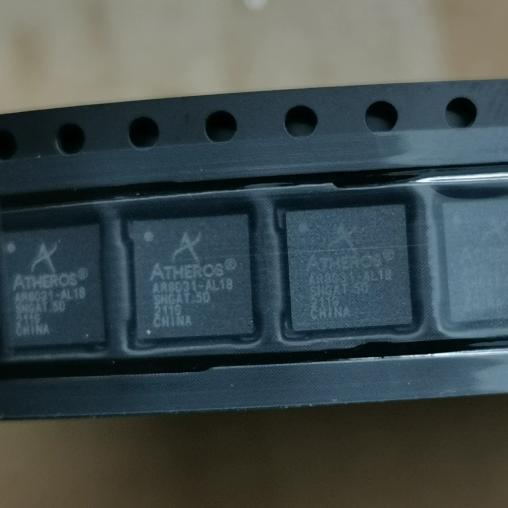
The AR8031-AL1B operates as the physical layer (PHY) transceiver in an Ethernet system, implementing the IEEE 802.3 physical layer functions to transmit and receive data over twisted-pair copper cable or fiber optic media.
Physical Coding Sublayer (PCS): The PCS handles the encoding and decoding of Ethernet frames for transmission over the physical medium. For 1000BASE-T, the PCS implements 4D-PAM5 (4-dimensional, 5-level pulse amplitude modulation) encoding, where 2 bits are encoded per symbol on each of the 4 wire pairs, achieving 1000 Mbps data throughput. For 100BASE-TX, the PCS implements 4B/5B encoding with MLT-3 signaling. For 10BASE-T, the PCS implements Manchester encoding.
Physical Medium Attachment (PMA): The PMA sublayer performs the analog front-end functions including the DAC (digital-to-analog converter) for transmission, the ADC (analog-to-digital converter) for reception, and the hybrid circuit that separates transmit and receive signals on the same wire pair (for 1000BASE-T full-duplex operation where all four pairs carry simultaneous bidirectional traffic).
Echo Cancellation and NEXT Cancellation: In 1000BASE-T full-duplex mode, all four pairs carry simultaneous transmit and receive signals. The AR8031 uses fully integrated digital adaptive equalizers, echo cancellers, and near-end crosstalk (NEXT) cancellers to separate the desired received signal from the transmitted signal (echo) and crosstalk from adjacent pairs. The echo canceller models the transmit-to-receive leakage path and subtracts the estimated echo from the received signal. The NEXT cancellers similarly model the crosstalk coupling between pairs and subtract the estimated crosstalk. These adaptive filters continuously update their coefficients during normal operation to track changes in cable characteristics and temperature.
Auto-Negotiation: The AR8031 implements IEEE 802.3u auto-negotiation to automatically determine the highest common speed and duplex setting with the link partner. During auto-negotiation, the PHY exchanges Fast Link Pulse (FLP) bursts that advertise its capabilities (10/100/1000 Mbps, half/full duplex, EEE, etc.). The highest common denominator is selected. The AR8031 also supports next-page functionality for 1000BASE-T auto-negotiation.
RGMII/SGMII MAC Interface: The MAC interface carries the Ethernet data between the PHY and the MAC layer in the processor or switch. In RGMII mode, the data is transferred on a 12-pin interface (TXD[3:0], TXC, TX_CTL, RXD[3:0], RXC, RX_CTL) at 125 MHz clock rate for 1000 Mbps operation. The RGMII supports both internal and external delay modes on the RX path to meet timing requirements. In SGMII mode, the data is transferred on a 2-pin differential serial interface (RX_p/n, TX_p/n) at 1.25 Gbaud, which is more pin-efficient for multi-port designs.
SerDes and Fiber Interface: The integrated SerDes (Serializer/Deserializer) provides a 1000BASE-X or 100BASE-FX fiber interface. In 1000BASE-X mode, the SerDes operates at 1.25 Gbaud using 8B/10B encoding, suitable for direct connection to SFP optical transceiver modules. The fiber mode is selected through MDIO register configuration or hardware strap options.
Energy Efficient Ethernet (EEE): The AR8031 supports IEEE 802.3az EEE, which reduces power consumption during periods of low link utilization. When EEE is active and there is no data to transmit, the PHY enters a low-power idle (LPI) state where the transmitter is turned off and the receiver operates in a reduced-power mode. The PHY periodically sends refresh signals to maintain the link partner’s equalizer adaptation. When data needs to be transmitted, the PHY exits LPI and resumes normal operation within a few microseconds.
IEEE 1588v2 PTP: The AR8031 supports the Precision Time Protocol (PTP) defined by IEEE 1588v2, which enables sub-microsecond clock synchronization between network nodes. The PHY can timestamp the arrival and departure of PTP packets with nanosecond precision, enabling accurate time synchronization for industrial automation, telecommunications, and financial applications.
Cable Diagnostics: The cable diagnostic test (CDT) feature uses time-domain reflectometry (TDR) to analyze the cable characteristics. By transmitting a test pulse and measuring the reflected signal, the PHY can determine the cable length, detect open circuits, short circuits, and impedance mismatches, and estimate the distance to any faults.





 English
  简体中文
简体中文  Español
  العربية