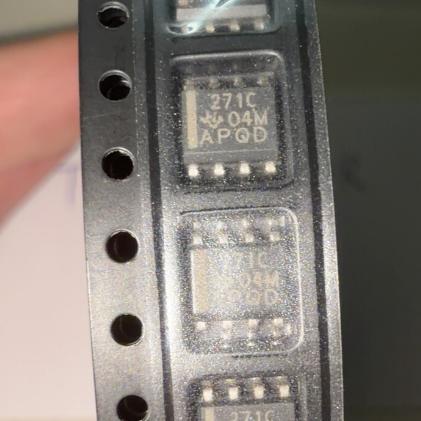
The TLC271CDR is a single operational amplifier from TI’s LinCMOS family, built on a silicon-gate CMOS process that provides the input characteristics of CMOS (extremely high input impedance, picoampere bias currents) with better offset voltage stability than conventional metal-gate CMOS op-amps. The LinCMOS technology achieves offset voltage drift of only 0.1 µV/month (including the first 30 days), far superior to the 10-100 µV/month typical of metal-gate CMOS.
The key differentiator of the TLC271 is the bias-select mode, controlled by the BIAS pin (pin 8). Three modes are available: High-Bias (BIAS pin to VDD+) for maximum bandwidth (1.7 MHz) and slew rate (3.6 V/µs); Low-Bias (BIAS pin to VDD-) for minimum power consumption (typical 10 µA supply current); and Medium-Bias (BIAS pin open or mid-voltage) for intermediate performance. This allows a single part to serve both high-performance and micropower applications.
In high-bias mode, the TLC271 offers 1.7-MHz GBW and 3.6-V/µs slew rate — competitive with bipolar op-amps like the LM358 — while consuming only 675 µA per channel. In low-bias mode, supply current drops to approximately 10 µA, suitable for always-on battery-powered circuits, at the expense of reduced bandwidth (~5 kHz) and slew rate.
The input common-mode voltage range extends 300 mV below the negative rail, enabling the TLC271 to sense signals at or below ground in single-supply systems. The output swings to within 30 mV of the negative rail (under light load), and within 1.2 V of the positive rail. The 60-pA maximum input bias current (0°C to 70°C) is orders of magnitude lower than bipolar op-amps, making the TLC271 suitable for high-impedance sensor interfaces (pH probes, photodiodes, piezoelectric transducers).
Three offset voltage grades are available: TLC271 (10 mV), TLC271A (5 mV), and TLC271B (2 mV). The C-suffix denotes commercial temperature range (0°C to 70°C); I-suffix covers -40°C to 85°C; M-suffix covers -55°C to 125°C. The TLC271 is in the process of being discontinued (per TI product page), so new designs should consider the TLC27L1 or TLV271 as replacements.





 English
  简体中文
简体中文  Español
  العربية