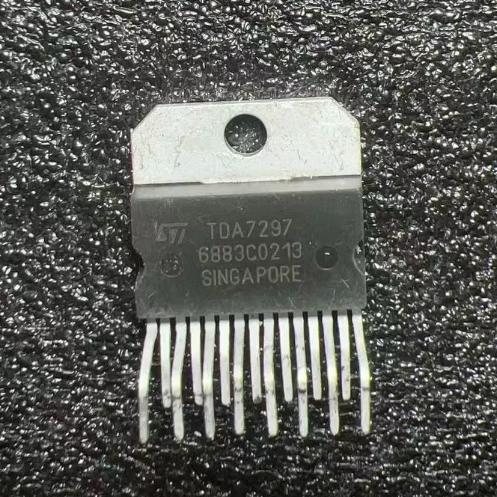
TDA7297


Dual bridge Class-AB audio amp, 15W+15W @ 8ohm, 6-18V, fixed 32dB gain, mute/standby, Multiwatt-15, 0~70C

2840

Effective Inventory
Go to Inquiry

Image for reference only

Manufacturer Part:

TDA7297

Package:

Multiwatt-15 (Vertical, Bent and Staggered Leads) (20.95 x 24.9 mm)

Brand:
Product Categories:
Other recommendations you may be interested in.
Description

The TDA7297 from STMicroelectronics is a dual bridge (stereo) Class-AB audio amplifier in a 15-pin Multiwatt package, delivering up to 15W + 15W output into 8-ohm loads at 16.5V supply. Operating supply voltage range: 6V to 18V (6.5V to 18V specified). The device features internally fixed gain of 32dB, requiring no external gain-setting resistors. No SVR (supply voltage rejection) capacitor, no bootstrap capacitor, and no Boucherot cell are needed, minimizing external component count. Built-in mute and standby functions allow microprocessor-controlled operation with pop-free turn-on. Short-circuit and thermal overload protection are integrated. Quiescent current: 50mA typical. Output peak current: 2A (internally limited). Maximum power dissipation: 33W at Tcase=70C. Power supply rejection: 56dB typical. For 4-ohm loads, supply voltage should not exceed 14V to limit distortion and power dissipation. Operating temperature: 0C to 70C. Through-hole Multiwatt-15 package with bent and staggered leads. Active product, RoHS compliant.

The TDA7297 from STMicroelectronics is a dual bridge (stereo) Class-AB audio power amplifier designed primarily for TV and portable radio applications. Housed in a 15-pin Multiwatt through-hole package, it delivers up to 15W per channel into 8-ohm loads when powered from a 16.5V supply, or 15W per channel into 4-ohm loads at 14.4V supply.

The device is characterized by its minimal external component requirement. Unlike many audio power amplifiers, the TDA7297 requires no SVR (supply voltage rejection) capacitor, no bootstrap capacitor, and no Boucherot cell (Zobel network) for stability. The gain is internally fixed at 32dB (approximately 40x voltage gain), eliminating external gain-setting resistors. This makes the TDA7297 one of the simplest audio amplifier ICs to implement, ideal for cost-sensitive consumer electronics.

The BTL (Bridge-Tied Load) output configuration doubles the voltage swing across the speaker compared to a single-ended output, enabling higher output power from a single supply voltage without requiring a coupling capacitor or split supply. Each channel uses two output stages in a push-pull H-bridge configuration, with the speaker connected between the two outputs (OUT+ and OUT-).

The mute and standby functions provide microprocessor-compatible control of the amplifier state. The standby function reduces power consumption by shutting down the output stages while keeping the bias circuits alive for fast recovery. The mute function silences the output without entering standby. Both functions can be controlled independently or tied together for simple on/off operation. A recommended RC network on the mute/standby pins provides pop-free turn-on by delaying the release of mute until the internal circuits have stabilized.

The TDA7297 includes comprehensive protection: short-circuit protection (between outputs and to ground) with internally limited peak output current of 2A, and thermal shutdown that activates when the junction temperature exceeds approximately 150C. The thermal resistance from junction to case (Rth j-case) is typically 1.4C/W (maximum 2C/W), requiring an appropriate heatsink for most applications.

For 8-ohm loads, the recommended supply voltage is 12V to 16.5V, with 16.5V providing the maximum output power. For 4-ohm loads, the supply voltage should be limited to 14V maximum to prevent excessive power dissipation and distortion. The quiescent current is 50mA typical, making the device relatively efficient for a Class-AB amplifier.

The device separates power ground (PW-GND, Pin 8) from signal ground (S-GND, Pin 9), allowing proper star-grounding practices to minimize ground-loop noise. The signal inputs (IN1 and IN2) are referenced to S-GND, while the output stages and supply pins are referenced to PW-GND.

The TDA7297 operates as a dual-channel Class-AB bridge-tied load (BTL) audio power amplifier with internally fixed gain.

Class-AB Output Stage: Each channel uses a Class-AB push-pull output stage, where both NPN and PNP (or N-channel and P-channel) output transistors are biased to conduct slightly at idle, eliminating the crossover distortion that characterizes pure Class-B designs. The small quiescent bias current (contributing to the 50mA total quiescent current) ensures smooth transition between the push and pull halves of the output waveform. This provides the low distortion (THD typically 0.1% or less at moderate power levels) expected from Class-AB operation.

Bridge-Tied Load (BTL) Configuration: Each channel uses two output amplifiers in an H-bridge configuration. The input signal is fed to the non-inverting input of one amplifier (driving OUT+) and simultaneously to the inverting input of the second amplifier (driving OUT-). The speaker is connected between OUT+ and OUT-, with no ground reference. This BTL configuration doubles the effective voltage across the speaker compared to a single-ended output: Vspeaker = 2 x Vsingle-ended. Since power is proportional to V-squared, the BTL configuration provides four times the output power of a single-ended amplifier from the same supply voltage (theoretically; in practice, current limiting and supply sag reduce this to approximately 3x).

The BTL configuration also eliminates the need for a large output coupling capacitor, as the DC offset across the speaker is nominally zero (both outputs sit at VCC/2). This is a significant advantage in TV and portable audio applications where size and cost are critical.

Internally Fixed Gain: The voltage gain is set internally at 32dB (approximately 40x) through internal feedback resistors. This simplifies the external circuit but means the gain cannot be adjusted. The 32dB gain implies that a 500mV RMS input signal produces a 20V RMS output, which would exceed the supply voltage. In practice, the maximum output is limited by the supply voltage and load impedance. For a 16.5V supply into 8 ohms, the maximum output power is approximately 15W, corresponding to about 11V RMS across the speaker, which requires approximately 275mV RMS input at 32dB gain.

Mute Function: When the MUTE pin (Pin 6) is pulled LOW (below approximately 2V), the output stages are muted – the output transistors are turned off, and the outputs present a high impedance. When MUTE is HIGH (above approximately 3.5V), the amplifier operates normally. The mute function provides a clean way to silence the output without disconnecting the power supply.

Standby Function: When the STANDBY pin (Pin 7) is pulled LOW, the entire amplifier enters a low-power standby state, reducing quiescent current to a few mA. When STANDBY is HIGH, the amplifier is fully operational. The standby state disables the bias circuits and output stages, but the internal reference and protection circuits remain active for fast recovery.

Pop-Free Turn-On: To achieve pop-free operation, the mute and standby pins are typically connected together and driven through an RC network. During power-up, the capacitor charges slowly, keeping the amplifier in standby+mute until the supply voltage has stabilized. Once the capacitor voltage exceeds the standby threshold, the bias circuits activate. Once it exceeds the mute threshold, the outputs are un-muted. This sequencing (standby releases before mute) ensures the amplifier is fully biased before the output is enabled, preventing turn-on transients (pops) from reaching the speaker.

Protection Circuits: The short-circuit protection limits the peak output current to approximately 2A. If the output current exceeds this limit (e.g., due to a shorted speaker wire), the output stage reduces the drive to maintain the current at or below the limit. The thermal protection monitors the junction temperature and shuts down the output stages if the temperature exceeds approximately 150C, preventing permanent damage. The amplifier automatically recovers when the temperature drops below the threshold.

Pin Name Type Description
1 OUT1+ Output Channel 1 non-inverting bridge output; connects to speaker 1 positive terminal; BTL output swings from near GND to near VCC
2 OUT1- Output Channel 1 inverting bridge output; connects to speaker 1 negative terminal; anti-phase with OUT1+
3 VCC Power Channel 1 supply voltage; 6V to 18V; decouple with 470uF electrolytic + 100nF ceramic capacitor to PW-GND
4 IN1 Input Channel 1 audio input; AC-couple through 0.22uF capacitor; referenced to S-GND; internally biased to VCC/2; 32dB fixed gain
5 N.C. No internal connection; leave floating
6 MUTE Input Mute control; LOW = output muted (high impedance); HIGH = normal operation; threshold approximately 2V LOW / 3.5V HIGH; use RC network for pop-free control
7 STANDBY Input Standby control; LOW = standby (low power); HIGH = normal operation; threshold similar to MUTE; typically tied to MUTE pin with RC delay
8 PW-GND Power Power ground; high-current return path for output stages; connect to power supply ground with thick PCB trace; separate from S-GND
9 S-GND Power Signal ground; low-current reference for input signals and bias circuits; connect to PW-GND at single point (star ground) to minimize ground loop noise
10 N.C. No internal connection; leave floating
11 N.C. No internal connection; leave floating
12 IN2 Input Channel 2 audio input; AC-couple through 0.22uF capacitor; referenced to S-GND; internally biased to VCC/2; 32dB fixed gain
13 VCC Power Channel 2 supply voltage; 6V to 18V; decouple with 470uF electrolytic + 100nF ceramic capacitor to PW-GND
14 OUT2- Output Channel 2 inverting bridge output; connects to speaker 2 negative terminal; anti-phase with OUT2+
15 OUT2+ Output Channel 2 non-inverting bridge output; connects to speaker 2 positive terminal; BTL output swings from near GND to near VCC
Application Description
Television Audio Primary application; dual 15W channels drive left and right TV speakers directly; 12V-16V supply available from TV power supply; mute/standby controlled by TV microcontroller; minimal external components reduce cost
Portable Radio / Micro System Compact stereo amplifier for portable CD/radio combos; 6V-15V battery or adapter operation; low external component count fits small PCB area; BTL output eliminates coupling capacitors
Desktop Powered Speakers Cost-effective stereo amplifier for multimedia speakers; 12V-15V wall adapter supply; 15W per channel sufficient for near-field listening; no bootstrap or SVR capacitors simplifies PCB layout
DIY Audio Projects Popular choice for hobbyist audio amplifiers due to simplicity; only requires power supply, input coupling capacitors, and speaker connections; through-hole Multiwatt package easy to hand-solder; widely available and low cost
Industrial Audio Annunciation PA system amplifier for alarms, announcements, and background music; mute/standby allows system controller to manage audio output; thermal and short-circuit protection ensure reliability in always-on installations
Model Manufacturer Compatibility Key Difference
TDA7266 ST Functionally Similar, Lower Power 7W+7W into 8 ohm (half the power); same Multiwatt-15 package; lower supply current; use when lower power is acceptable; lower cost
TDA7266B ST Functionally Similar Similar to TDA7266 with different gain options; 7W+7W; check datasheet for specific feature differences
TDA7377 ST Functionally Similar Quad bridge or stereo + bridge-triple configuration; more flexible topology; similar power output; Flexiwatt-25 package; different pinout
TDA7294V ST Higher Power Alternative 100W mono Class-AB amplifier; DMOS output stage; much higher power; different application segment; Multiwatt-15 vertical package; requires more external components
PAM8403 Diodes Inc Class-D Alternative 3W+3W Class-D amplifier; much higher efficiency (>90%); no heatsink needed; 5V supply; lower power but much smaller solution; DIP-16 or SOP-16 package
Recommend Parts
Cortex-M0+ ultra-low-power MCU, 32MHz, 128KB Flash, crystal-less USB, LQFP-64

Brand:

Package:

LQFP-64 (10×10 mm)
In stock:
14446pcs

Cargo cycle: 3~7 Days
The minimum order is 1

Go to Inquiry
Cortex-M4F MCU, 168MHz, 512KB Flash, 192KB SRAM, Ethernet, USB OTG, LQFP-100

Brand:

Package:

LQFP-100 (14×14×1.4 mm)
In stock:
2870pcs

Cargo cycle: 3~7 Days
The minimum order is 1

Go to Inquiry
ARM Cortex-M4F MCU, 72MHz, 384KB Flash, 64KB SRAM, dual ADC, 4 comparators, 2 op amps, LQFP-100

Brand:

Package:

LQFP-100 (14 x 14 x 1.4 mm)
In stock:
12274pcs

Cargo cycle: 3~7 Days
The minimum order is 1

Go to Inquiry
ARM Cortex-M4F MCU, 168MHz, 1MB Flash, 192KB SRAM, Ethernet, USB OTG HS, UFBGA-176

Brand:

Package:

UFBGA-176 (10 x 10 mm, 0.65mm pitch)
In stock:
9303pcs

Cargo cycle: 3~7 Days
The minimum order is 1

Go to Inquiry
Quad JFET-input op amp, 4MHz GBP, 16V/µs slew rate, 200pA bias current, SOIC-14

Brand:

Package:

SOIC-14 (8.75 x 4 x 1.65 mm)
In stock:
9834pcs

Cargo cycle: 3~7 Days
The minimum order is 1

Go to Inquiry
Ultra-low-power Cortex-M3 MCU, 32MHz, 256KB Flash, 32KB SRAM, LCD controller, LQFP-64

Brand:

Package:

LQFP-64 (10x10mm)
In stock:
5417pcs

Cargo cycle: 3~7 Days
The minimum order is 1

Go to Inquiry
Quality Assurance

All electronic components we source from our partnered supply chains go through strict incoming inspections.Through careful testing, we ensure everything delivered to customers is genuine original parts and meets quality requirements.In addition, we keep complete inspection records to make the entire supply chain process clear and traceable.

Certification
We have obtained a number of professional certifications and built our own professional testing laboratory.This ensures that every product we deliver to our customers meets the highest quality requirements.We conduct tests in strict accordance with procedures to ensure stable product quality and accurate parameters.To guarantee genuine original parts, we also cooperate with reliable third-party testing institutions for strict quality inspection.We always attach great importance to quality and fully comply with industry standards, relevant regulations, and ISO 9001:2015 requirements.

Shipping & Payment

All electronic components we source from our partnered supply chains go through strict incoming inspections.Through careful testing, we ensure everything delivered to customers is genuine original parts and meets quality requirements.In addition, we keep complete inspection records to make the entire supply chain process clear and traceable.

Certification
We have obtained a number of professional certifications and built our own professional testing laboratory.This ensures that every product we deliver to our customers meets the highest quality requirements.We conduct tests in strict accordance with procedures to ensure stable product quality and accurate parameters.To guarantee genuine original parts, we also cooperate with reliable third-party testing institutions for strict quality inspection.We always attach great importance to quality and fully comply with industry standards, relevant regulations, and ISO 9001:2015 requirements.

Service & Packaging

All electronic components we source from our partnered supply chains go through strict incoming inspections.Through careful testing, we ensure everything delivered to customers is genuine original parts and meets quality requirements.In addition, we keep complete inspection records to make the entire supply chain process clear and traceable.

Certification
We have obtained a number of professional certifications and built our own professional testing laboratory.This ensures that every product we deliver to our customers meets the highest quality requirements.We conduct tests in strict accordance with procedures to ensure stable product quality and accurate parameters.To guarantee genuine original parts, we also cooperate with reliable third-party testing institutions for strict quality inspection.We always attach great importance to quality and fully comply with industry standards, relevant regulations, and ISO 9001:2015 requirements.