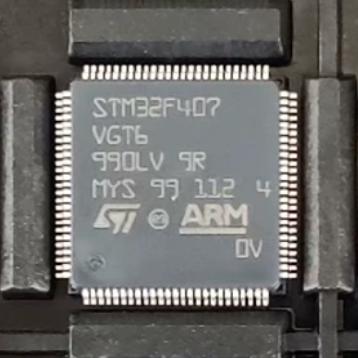
The STM32F407VGT6 from STMicroelectronics is a high-performance ARM Cortex-M4 microcontroller that represents one of the most versatile devices in the STM32F4 series. It combines a 168 MHz Cortex-M4 core with single-precision FPU and DSP instructions, 1 Mbyte of Flash, and an exceptionally rich set of peripherals, making it suitable for a wide range of demanding embedded applications.
The STM32F407VGT6 sits in the 100-pin LQFP package, which exposes 82 GPIO pins. This is the sweet spot in the STM32F407 product line: the 64-pin LQFP-64 package loses too many peripherals to pin constraints, while the 144-pin and 176-pin packages add GPIO ports H and I (PH and PI) that are only available in those larger packages. The LQFP-100 package provides access to all major peripherals including Ethernet, USB HS, FSMC, and the camera interface, making it the most popular choice for designs that need the full peripheral set without the cost and board space of the larger packages.
The Cortex-M4 core with FPU is the key differentiator from the Cortex-M0 and Cortex-M3 based STM32 devices. The FPU accelerates floating-point calculations by 5-10x compared to software emulation, making the STM32F407VGT6 suitable for digital signal processing (audio processing, sensor fusion, motor control algorithms), scientific calculations, and any application that uses floating-point arithmetic. The DSP instructions (MAC, saturating arithmetic, SIMD) further accelerate signal processing algorithms.
The ART (Adaptive Real-Time) Accelerator is a critical innovation that enables 0-wait-state execution from Flash memory at 168 MHz. Without the ART Accelerator, Flash memory access times would require multiple wait states at high clock frequencies, significantly reducing the effective execution speed. The ART Accelerator uses a instruction cache, a literal cache, and a prefetch queue to eliminate these wait states, delivering the full 210 DMIPS performance of the Cortex-M4 core.
The 1 Mbyte of Flash memory provides ample space for complex application code, RTOS, communication stacks (TCP/IP, USB), and data logging. The 192 Kbytes of SRAM is divided into 128KB of main SRAM and 64KB of CCM (Core Coupled Memory). The CCM is a zero-wait-state memory that is accessible only by the CPU (not by DMA), making it ideal for time-critical code and data that must execute at maximum speed without DMA bus contention.
The advanced connectivity peripherals distinguish the STM32F407 from the STM32F405: the STM32F407 adds a 10/100 Ethernet MAC with IEEE 1588v2 hardware timestamping and an 8-14 bit camera interface. These features make the STM32F407VGT6 particularly suitable for IoT gateways, industrial Ethernet devices, networked sensors, and vision applications.
The dual USB OTG interfaces are another distinguishing feature. The USB FS (full-speed, 12 Mbit/s) OTG controller includes an on-chip PHY and can operate in device, host, or OTG mode. The USB HS (high-speed, 480 Mbit/s) OTG controller includes a dedicated DMA and on-chip full-speed PHY; for high-speed operation, an external ULPI PHY is required. Having two independent USB interfaces allows simultaneous device and host operation.
The FSMC (Flexible Static Memory Controller) allows direct connection to external NOR Flash, NAND Flash, PSRAM, SRAM, and Compact Flash devices, enabling memory expansion beyond the on-chip 1MB Flash. This is particularly useful for applications requiring large data storage (maps, fonts, images) or executing code from external memory.





 English
  简体中文
简体中文  Español
  العربية