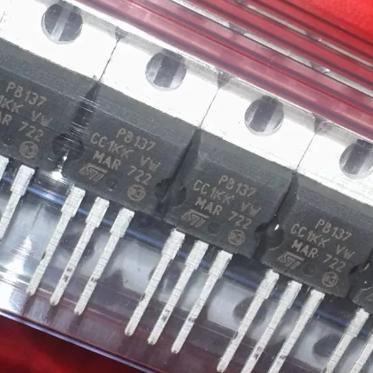
The PB137ACV from STMicroelectronics is a specialized positive voltage regulator designed specifically for lead-acid battery charger applications. It provides a fixed 13.7V output at up to 1.5A, which corresponds to the correct float charge voltage for a 12V lead-acid battery. The device is housed in a 3-pin TO-220 through-hole package and incorporates comprehensive protection features including internal current limiting, thermal shutdown, and safe area protection.
The 13.7V output voltage is the key specification that defines this device. For a 12V lead-acid battery (which typically consists of six 2V cells in series), the float charge voltage at 25C is approximately 13.5-13.8V. The PB137’s 13.7V output with plus/minus 1% tolerance (13.56-13.84V at 25C) falls precisely within this range, making it an ideal single-component solution for maintaining a lead-acid battery at full charge without overcharging.
The most distinctive feature of the PB137 is its extremely low reverse leakage current. When the input voltage is floating (i.e., the charger is unplugged) and the output is connected to the battery at 13.7V, the reverse leakage current is less than 10uA over the 0-40C temperature range. This is critical because any reverse leakage would slowly discharge the battery through the regulator when the charger is disconnected. Standard linear regulators can have reverse leakage currents of several milliamps, which would drain a lead-acid battery over time. The PB137’s sub-10uA reverse leakage ensures negligible battery drain.
The internal current limiting is set to approximately 2.2A (typical at VI-VO=5V, TJ=25C), which protects both the regulator and the battery from excessive charging current. When the battery is deeply discharged and its terminal voltage is low, the voltage difference across the regulator (VI-VO) is large, and the current would be very high without limiting. The PB137 automatically limits the current to a safe level, and as the battery charges and its voltage increases toward 13.7V, the voltage drop across the regulator decreases and the charging current naturally tapers off.
The thermal shutdown and safe area protection work together to prevent damage under fault conditions. If the junction temperature exceeds the thermal shutdown threshold (typically around 150C), the output current is reduced, limiting the power dissipation. The safe area protection ensures that the device operates within its safe operating area (SOA) under all combinations of voltage and current, preventing secondary breakdown. These protections make the device essentially indestructible under normal operating conditions.
The dropout voltage of 2.1V typical at 1A means the input voltage must be at least 15.8V (13.7V + 2.1V) to maintain regulation at 1A output. For the full 1.5A output, the dropout voltage increases, requiring an input voltage of at least 16-17V. The maximum input voltage of 40V provides adequate margin for unregulated transformer/rectifier supplies that may have significant ripple and voltage variation.
The PB137ACV is the plus/minus 1% tolerance version (AC suffix). The standard PB137CV version has a wider tolerance. The device has been marked as Obsolete by STMicroelectronics, meaning it is no longer in active production. Designers should consider alternative solutions for new designs, although the PB137ACV may still be available from distributor stock or specialized suppliers.
For lead-acid battery charger applications, the PB137ACV provides the simplest possible design: connect the input to a rectified and filtered AC supply (16-28V typical), add an input capacitor (1uF minimum) and an output capacitor (10uF recommended), and the battery is charged at the correct float voltage with built-in protection. No external current limiting, no voltage setting, and no temperature compensation are required for basic float charge applications.





 English
  简体中文
简体中文  Español
  العربية