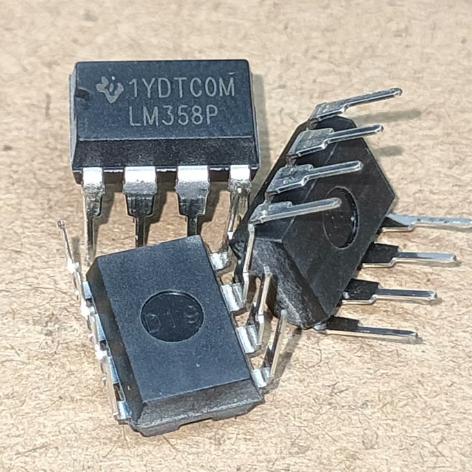
The LM358P from Texas Instruments is the through-hole PDIP-8 version of the LM358, one of the most widely used dual operational amplifiers in the electronics industry. First introduced in the 1970s, the LM358 family remains in high-volume production due to its simplicity, low cost, wide availability, and single-supply capability. The ‘P’ suffix specifically denotes the plastic DIP-8 package for through-hole mounting, favored in prototyping, education, and industrial applications requiring manual soldering or socket installation.
The LM358 contains two independent op-amps sharing common VCC and GND pins. Each amplifier features internal dominant-pole compensation for unity-gain stability, eliminating the need for external compensation components. The input common-mode voltage range includes ground (0 V), which is the defining feature that distinguishes the LM358 from older dual-supply op-amps like the LM741. This allows the LM358 to directly amplify signals near ground without a negative supply rail.
The output swings from approximately 5 mV above ground (no load) to VCC – 1.5 V. The output can source 40 mA and sink approximately 20 mA at VCC = 15 V, sufficient for driving LEDs, small relays, and logic-level signals. The 500-µA per-amplifier quiescent current is modest for bipolar op-amps and is essentially independent of supply voltage.
The LM358P is electrically identical to the LM358N (ON Semiconductor’s PDIP-8 version) and LM358PT (ST’s PDIP-8 version). These parts are fully interchangeable in most applications. TI also offers the LM358B (3-36 V, 3-mV Vos, EMI filtering, 1.2-MHz GBW) as a drop-in upgrade for new designs.
The LM358 is the dual-channel companion to the LM324 quad op-amp. The two devices share identical amplifier cells and specifications, differing only in channel count and package. Designers needing only two amplifiers should use the LM358 to save board space; those needing four should use the LM324.





 English
  简体中文
简体中文  Español
  العربية