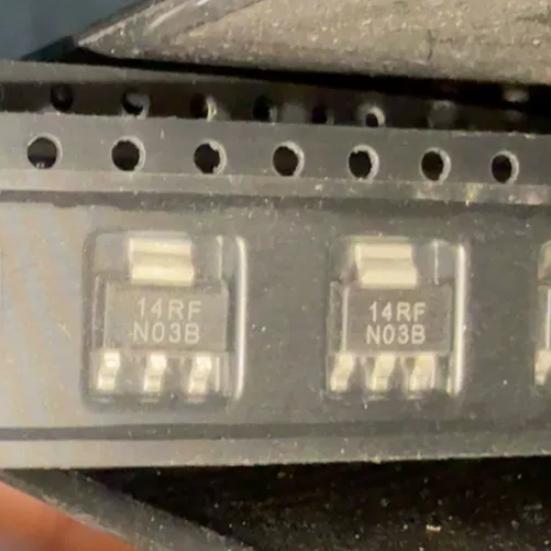
The LM1117MPX-ADJ is the adjustable-output version of TI’s LM1117 low-dropout linear regulator in a SOT-223-4 surface-mount package with tape-and-reel packaging. The LM1117 is one of the most widely used LDO regulator families in the electronics industry, originally developed by National Semiconductor (now TI).
The adjustable version uses an internal 1.262 V bandgap reference trimmed to ±1% accuracy. The output voltage is set by two external resistors: VOUT = VREF × (1 + R1/R2) + IADJ × R1, where IADJ is typically 50 µA and can usually be neglected. This allows any output voltage from 1.25 V to 13.8 V with a single BOM change.
The 1.2 V typical dropout voltage at 800 mA (1.3 V max) means the input must be at least 1.3 V above the desired output for proper regulation. At lower currents, dropout scales proportionally: approximately 1.1 V at 100 mA and 1.25 V at 500 mA.
The SOT-223-4 package features a large tab (pins 2 and 4) connected to VOUT that serves as both the output connection and the primary thermal path. With RθJA of approximately 136°C/W on a standard FR4 board, the package can dissipate about 0.9 W at 50°C ambient.
TI also offers the LM1117I variant with -40°C to +125°C extended temperature range. For new designs, TI recommends the TLV1117 as a drop-in replacement with improved performance, or the TLV761 for fixed-voltage SOT-223 configurations with enhanced functionality.
Note: The LM1117MPX-ADJ (without /NOPB suffix) is listed as obsolete by some distributors. The LM1117MPX-ADJ/NOPB with Pb-free terminal finish remains active. Designers should specify the /NOPB variant.





 English
  简体中文
简体中文  Español
  العربية