
Korea’s $650 Billion Semiconductor Gambit Meets Global Component Price Surge: A Supply Chain Under Siege
The global electronic components supply chain is experiencing its most significant structural realignment since the 2020–2022 chip shortage — but this time, the drivers are fundamentally different. AI infrastructure investment has permanently reshaped demand patterns, creating sustained scarcity in memory, power devices, passive components, and mature-node logic that no cyclical downturn is likely to resolve.
South Korea’s announcement of a 800 trillion KRW ($518 billion) investment to build four new semiconductor fabs — combined with Samsung and SK Hynix’s separate 1,000 trillion KRW decade-long investment plan — represents the largest industrial mobilization in the country’s history. Yet even this unprecedented commitment will not meaningfully ease supply constraints before 2028.

The Price Surge: Broad-Based and Structural
Since late 2025, the semiconductor and electronic components industry has entered a wave of price increases that spans virtually every product category:
- Analog ICs: TI implemented increases of 15–85% effective April 2026, its second major hike in six months. ADI raised prices by an average of 15%, with military-grade products up 30%.
- MCUs and FPGAs: Xilinx increased classic series by 20%, Lattice by 10%. NXP adjusted automotive MCU prices effective April 1, with Infineon and Renesas following.
- Power devices: Infineon and Silan Microelectronics raised quotes by at least 10%. Onsemi implemented April 1 price adjustments for power, industrial, and data center applications.
- Passive components: Yageo, Panasonic, and others raised prices 10–30%. TE Connectivity and Molex connectors saw 5–15% increases.
- Memory: Samsung DRAM prices doubled in Q1 2026, with NAND set for another 100% increase in Q2. Automotive DRAM spot prices surged up to 300%.
This is not speculative pricing. The underlying drivers — raw material cost inflation, AI-driven demand reallocation, and structural supply constraints at mature process nodes — are durable and self-reinforcing.
The Memory Supercycle
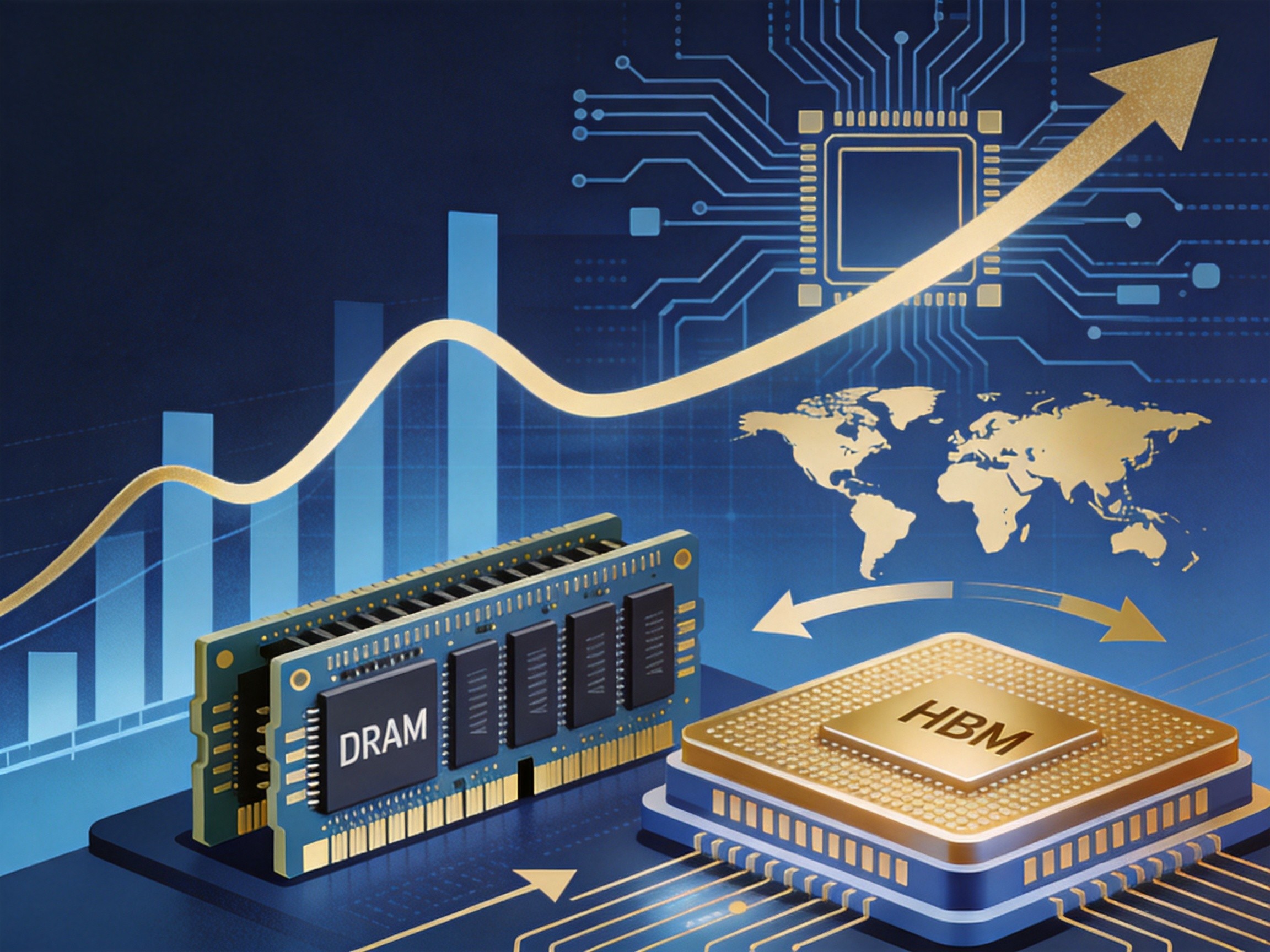
The memory market has undergone the most dramatic transformation. DRAM has transitioned from a cyclical commodity to what analysts now describe as a “strategic compute resource.” Key metrics tell the story:
- Major DRAM supplier inventories have dropped to 3–5 weeks — near critical levels
- HBM now consumes 23% of total DRAM wafer capacity, with over 70% of capacity allocated to AI-related products
- SK Hynix and Micron have sold out their entire 2026 HBM capacity months in advance
- Legacy MLC NAND faces a projected 40% supply gap in H2 2026 as Kioxia and Samsung exit the segment
Passive Components: From Commodity to Constraint
Perhaps the most telling indicator of structural change is in passive components — the resistors, capacitors, and inductors that traditionally operated in quiet commodity markets. In 2026, these “invisible” components have become design parameters:
- AI server MLCC demand: A single high-end AI server requires tens of thousands of MLCCs — 5–10× more than a traditional server. NVIDIA’s latest platforms have driven a dramatic increase in high-frequency, high-capacitance MLCC requirements.
- Automotive grade tightness: EV per-vehicle MLCC counts have reached 18,000–30,000+, with automotive-grade lead times extending to 26–40 weeks. AEC-Q200 certification requirements create multi-year barriers to entry.
- Tantalum capacitor escalation: Yageo’s KEMET unit announced its third price increase on polymer tantalum capacitors since H2 2025, driven by AI server demand for high-capacitance, low-ESR components.
The passive component market is projected to grow from $48.2 billion in 2026 to $74.3 billion by 2033 at a 6.4% CAGR, with capacitors holding over 35% market share and inductors growing fastest at 9.7% CAGR.
The Foundry 2.0 Paradigm Shift
Counterpoint Research’s latest foundry tracker confirms that Q1 2026 global foundry revenue reached $86 billion, up 23% year-over-year. But the more significant story is the shift from “Foundry 1.0” (wafer manufacturing only) to “Foundry 2.0” (integrated manufacturing, advanced packaging, and testing).
Key findings:
- TSMC Q1 revenue grew 41% YoY, with the company reallocating mature-node capacity toward advanced processes
- ASE raised its 2026 LEAP advanced packaging revenue target above $3.5 billion
- Amkor’s Q1 revenue hit a record, up 25% YoY, driven by advanced packaging utilization
- Tongfu grew 29% on AMD AI packaging, while KYEC surged 45% on extended AI test cycles
Advanced packaging — particularly CoWoS — has become the critical bottleneck in AI hardware deployment. The companies that control packaging capacity increasingly control the pace of AI infrastructure buildout.
Mature Node Squeeze: The Hidden Crisis
While AI dominates headlines, a less visible crisis is unfolding at mature process nodes (28nm and 40nm) — the backbone of industrial controllers, automotive systems, and medical devices. These nodes were supposed to have abundant capacity as the industry migrated to advanced processes. Instead, utilization has reached 98–102%.
The consequence: lead times for mature-node components have stretched from 6–8 weeks to 16–20 weeks, with allocation restrictions. Secondary sourcing is no longer viable — secondary suppliers have their own waiting lists. This squeeze is particularly acute for analog and mixed-signal ICs used in industrial automation, where 28nm, 22nm, and 16nm nodes deliver the precision required for sensor interfaces.
Strategic Outlook
The electronic components supply chain has entered a new regime where AI-driven demand creates permanent structural scarcity in specific product categories, even as other segments remain well-supplied. This “segmented allocation tension” — tight supply for high-performance, automotive-grade, and AI-adjacent components alongside ample availability of commodity parts — is the defining characteristic of the 2026 market.
For procurement and engineering teams, the imperative is clear: segment components by criticality, monitor lead times for strategic families, buffer selected items, and align design decisions with supply chain reality. The companies that treat component sourcing as a strategic function — not a procurement afterthought — will be the ones that maintain production continuity through 2028.
Key Takeaways
- South Korea’s $650B+ semiconductor investment is the largest industrial mobilization in its history, but new capacity won’t ease constraints before 2028
- Price increases of 10–85% span analog ICs, MCUs, FPGAs, power devices, passives, connectors, and memory — driven by structural AI demand, not cyclical factors
- DRAM has transformed from a cyclical commodity to a strategic compute resource, with supplier inventories at 3–5 weeks and HBM consuming 23% of wafer capacity
- Passive components have shifted from invisible commodities to design-critical constraints, with MLCC lead times reaching 26–40 weeks for automotive-grade parts
- Mature-node (28/40nm) utilization has reached 98–102%, creating a hidden crisis for industrial, automotive, and medical component supply
 English
  简体中文
简体中文  Español
  العربية