
Counterfeit products are no longer limited to luxury goods like handbags and watches — the semiconductor and electronic components industry has also been flooded with fake parts in recent years. Modified, remarked, and imitation chips are widespread across the supply chain. Once counterfeit electronic components make it to your production line, you may face mass product defects and project delays at minimum. In severe cases, burnt equipment and massive financial losses will bring irreversible damage to your business.
With a chaotic spot component market, how can buyers and engineers quickly verify component authenticity without professional testing equipment? This article shares 7 visual inspection methods that anyone can operate, plus supplementary inspection tips. Even beginners can easily identify refurbished and counterfeit chips.
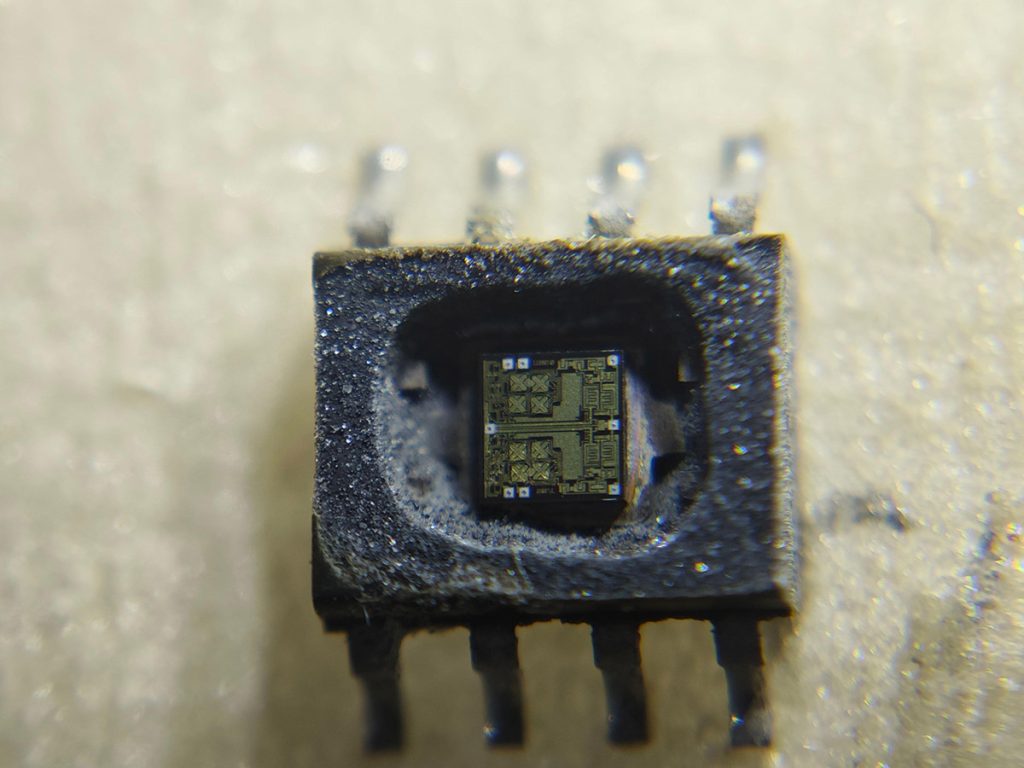
1. Inspect Surface Sanding Marks
Sellers of counterfeit chips commonly sand off original marking layers to erase old part numbers and reprint new labels.
- Sanded chip surfaces bear fine horizontal scratches. Faint traces of original printing will be visible under magnification.
- A thin glossy coating is often sprayed over sanded surfaces to cover blemishes. Such chips look overly shiny and lack the subtle matte texture of genuine plastic packaging.
- Brand-new original ICs feature uniform molding without extra coatings, scratches, or abrasive sanding traces.
2. Check Plating Texture of Component Pins
Pin appearance is one of the most intuitive ways to separate refurbished goods from authentic stock:
- Refurbished chips get re-tinned pins that appear unnaturally bright and reflective.
- Pins of genuine ICs feature matte silver-toned plating with even, dim coloration, free of reflective glare or oxidation spots.
- For DIP through-hole components: genuine brand-new pins are perfectly smooth with zero scratches. If secondary-packaged chips have scratches, all marks run in a consistent direction with clean, rust-free exposed metal. Chips with crooked pins and random scattered scratches are almost certainly refurbished.
3. Verify Marking Printing Technology
Official chip manufacturers use laser engraving or dedicated industrial printing machines for part marking, while counterfeiters cut corners with low-quality printing processes. Key distinguishing factors:
- Print clarity: Original markings feature smooth, uniform edges that cannot be wiped off with chemical solvents. Re-marked counterfeit text shows jagged borders, blurred uneven ink, and erases easily when wiped with alcohol.
- Printing process: Leading semiconductor brands have long phased out screen printing. Counterfeiters still rely on this cheap method, leaving slightly raised lettering that feels rough and uneven to the touch.
- New counterfeiting alert: Affordable small laser engravers are widely available now, so many refurbished chips also use laser re-marking. Visual differentiation alone becomes difficult — always cross-check with batch codes and packaging shapes for confirmation.
4. Cross-Check Production Date Codes & Package Factory Labels
All authentic chips carry matching markings on both the top surface and bottom base. Remarked counterfeit chips expose obvious inconsistencies:
- Genuine chips feature matching model numbers, factory batch codes, and production date codes (D/C) on both sides. The manufacturing date always aligns with the physical condition of the component.
- Unsanded refurbished chips show mismatched top/bottom labels with production years spanning wide ranges. Re-marked chips often carry illogical numerical codes (random favorable-looking numbers). Mismatched messy base labels also prove the part has been reworked.
5. Measure Component Thickness & Examine Molded Edge Corners
This inspection method delivers extremely high accuracy for sanded refurbished power semiconductors:
- Deep sanding is required to fully erase original laser markings, resulting in chips noticeably thinner than official standard dimensions. Use a caliper to compare against genuine reference samples.
- Genuine plastic-molded chips form smooth rounded R-corners during injection molding and demolding. Deep sanding grinds these rounded edges into sharp right angles — any chip with sharp straight edge corners is confirmed sanded counterfeit stock.
6. Special Inspection for Tantalum Capacitors: Complete Body Markings
AVX SMD tantalum capacitors are among the most widely counterfeited passive components. Genuine units carry 4 full lines of printed information split into two rows: AVX brand logo, capacitance value, rated voltage, and production batch code — all four details must be present.
The most common flaw on fake tantalum capacitors is a missing AVX logo in the top-left corner. Small form-factor units require a magnifying glass to read fine print. Any capacitor missing any printed parameter is counterfeit.
7. Cross-Reference Official Datasheets for Part Specifications
This ultimate anti-counterfeit method works best for rare, hard-to-source component models:
- If the part number provided by your supplier has no matching specifications on the manufacturer’s official datasheet, there is over a 90% chance it is counterfeit.
- Non-standard niche component specifications are rarely mass-produced by manufacturers. Authorized distributors never stock such items. Even custom orders come with high minimum order quantities, long lead times, and large advance deposit requirements. Low-cost readily available stock of niche parts is almost always re-marked refurbished chips.
Supplementary Multi-Check Tips for Higher Verification Accuracy
A single suspicious feature only raises doubts. Multiple inconsistent signs together confirm defective counterfeit components. Three extra quick inspection checks:
- Locating hole inspection: Locating holes on authentic chips feature consistent depth and size. Holes on sanded refurbished chips vary drastically in depth or get fully ground flat. Faint residual traces of original holes are visible under magnification.
- Original packaging verification: Legitimate spot inventory comes with complete factory packaging including anti-static bags and printed outer cartons. All labels on inner and outer packaging must match the part number, batch code, and quantity. Components sold loose without official factory packaging carry high counterfeit risk.
- Auxiliary tool inspection: When visual judgment is unclear, use a digital magnifier to check for tiny micro-pores across sanded chip surfaces. Genuine brand-new molded chips have smooth pore-free surfaces.
Global semiconductor supply chains remain tight, driving steep price hikes for end-of-life (EOL) obsolete parts and hard-to-find spot components — simultaneously expanding the counterfeit chip industry. Buyers and production engineers should never only verify part numbers when receiving shipments.
Cross-reference all 7 inspection methods covered above, and perform full checks covering surface condition, pins, marking print, batch codes, packaging molding, official specifications, and factory packaging. This process fully blocks counterfeit chips from entering your production line.
For bulk long-term procurement and high-value semiconductor chips, prioritize authorized official distributors and reliable spot suppliers with complete quality inspection workflows. Reduce counterfeit risks at the source and avoid costly production losses.
 English
  简体中文
简体中文  Español
  العربية